
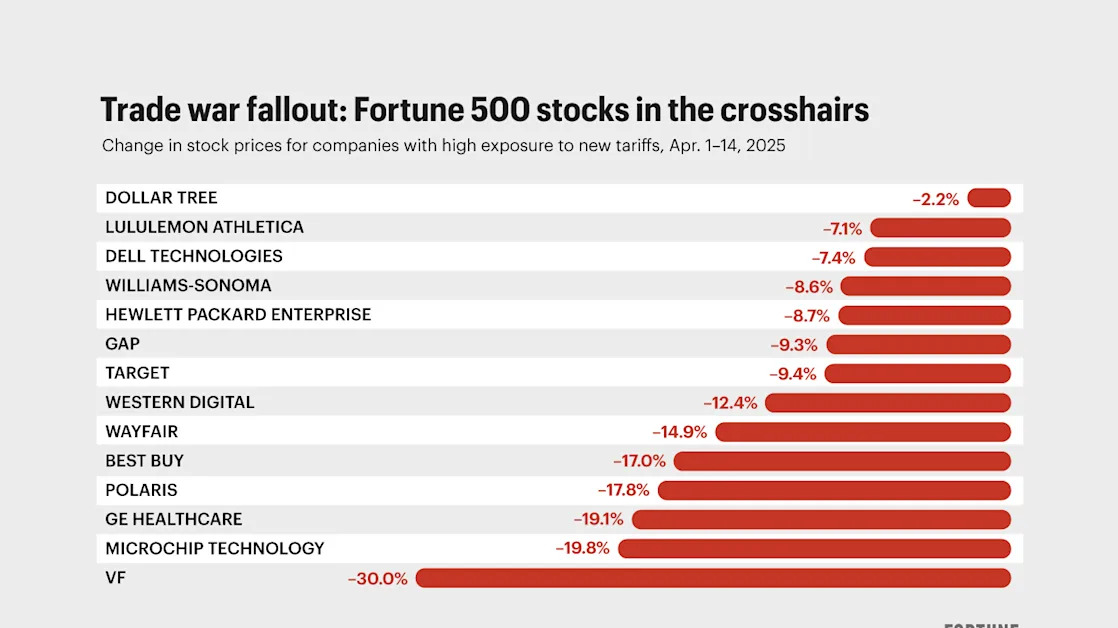
The 14 Fortune 500 stocks most exposed to the tariff war
Tariff uncertainty is
roiling the markets
and leaving major companies in a state of heightened alert. The global stock market plummeted after President Donald Trump instituted tariffs for the vast majority of the U.S.’s trading partners on April 2, wiping out trillions of dollars of wealth in the process. While the market rebounded after Trump announced
a 90-day pause
on certain tariffs, others are still in effect—notably a 10% tariff on nearly all global imports, a 25% levy on imported cars and auto parts, and a 145% tariff on goods imported from China are in effect as well. Companies are already feeling the pain—and some more than others.
To get a sense of which companies are getting hit hardest by tariff turmoil,
Fortune
parsed stock market data from Morningstar. The findings are shown in the chart below, which identifies 14 Fortune 500 companies, along with their rank and industry sector, and shows how their share prices performed since tariffs began to bite.
View this interactive chart on Fortune.com
Apparel and retail
As the chart shows, the stock price of
VF
Corporation (
No. 355
) has been hit particularly hard, declining 30%. The global apparel and footwear company is known for its portfolio of brands, including The North Face, Timberland, and Vans. VF has a strong reliance on China and Vietnam—both prime targets for Trump’s tariffs—for
its suppliers
.
Meanwhile,
Wayfair
(
No. 346)
, the online retailer of home goods, has experienced a 15% drop. The company has higher exposure to Vietnam than some of its competitors. Shares of athletic apparel retailer Lululemon (
No. 411
) fell 7%.
Industrials, hardware, semiconductors
The stock price for Arizona-based
Microchip Technology
(
No. 447
), a semiconductor company, was down about 20%. The company made its debut on the Fortune 500 in 2024. Currently, semiconductors are excluded from the tariff increases, but the stock price took a hit over concerns demand for chips would weaken. Microchip Technology’s woes could soon worsen as the Trump administration is now
eying new tariffs
on semiconductors.
Western Digital
(
No. 334
), a data storage company, saw its stock price fall about 12%. The company has a significant
presence in China
. Shares of
Dell Technologies
(
No. 48
) dipped 7% and
HP
Enterprise’s (
No. 147
) stock price fell about 9%.
Medical technology and devices
The stock price of GE Healthcare Technologies (
No. 206
) fell 19%. Last week, GE Healthcare was among the U.S. companies that participated
in a roundtable
with China’s Ministry of Commerce. Despite ongoing trade tensions and China’s retaliatory tariffs, the vice minister of commerce said the country remains committed to reform and opening up.
Vehicles and parts
Minnesota-based
Polaris
(
No. 431
) experienced an 18% drop. The manufacturer of power sports vehicles and related products has its
largest factory
in Monterrey, Mexico, where it once benefited from a long-standing North American free trade regime—one that Trump has upended with new tariffs, including on the auto sector.
Cyclical and special retail
Best Buy’s (
No. 100
) stock price has experienced a 17% dip. While the company only directly imports 2% to 3% of its own inventory, its costs are dependent on a complex supply chain that includes vendors heavily exposed to tariffs,
Fortunereported
. In March, the consumer electronics retailer warned of potential price pressure due to tariffs.
The stock prices of clothing retailer
Gap
(
No. 278
) and home furnishing company
Williams-Sonoma
(
No. 474
) were down about 9%. Gap
sources
less than 10% of its product from China and less than 1% comes from Canada and Mexico combined, CEO Richard Dickson told
Yahoo
Finance in March. Dickson said the company has strengthened its supply chain over the last several years and will continue to diversify its product manufacturing footprint.
During the most recent
earnings call
, Williams-Sonoma CEO Laura Alber addressed the company’s supply chain. “We’ve been moving goods away from China. We’ve cut it substantially. We intend to continue to cut it substantially.”
Consumer defensives
Target
(
No. 37
) shares were down 9%. Target has reduced its reliance on China to about 30% of imports from more than 60%, Target CEO Brian Cornell
recently said
.
Shares of bargain retailer
Dollar Tree
(
No. 143
) were down about 2%, less than the 4% drop in the S&P 500 Index.
