
Carriers big and small at TCA wait for signs of freight market turnaround

PHOENIX – If there was a freight market bull at the annual meeting of the Truckload Carriers Association, that person was keeping pretty quiet.
Conversations from the stage, at receptions and at meals had a consistent theme: Can you believe we’re still talking about this freight recession? In 2025? Didn’t we say at this meeting last year that things would be better by the end of 2024?
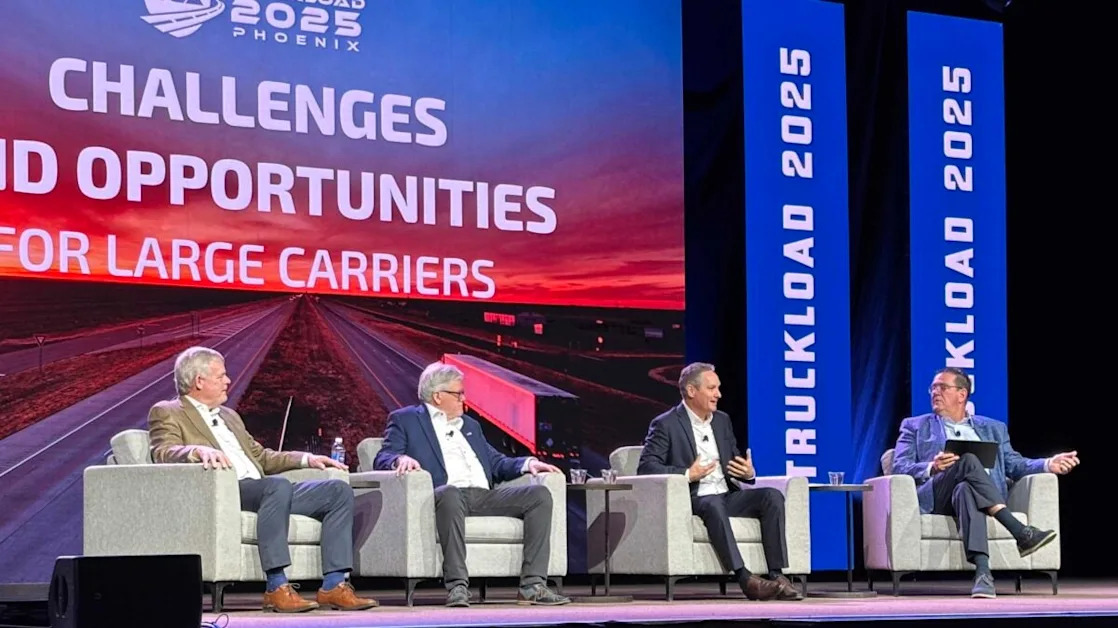
At the Large Carrier panel, Dave Williams, senior vice president of equipment and government relations at Knight Swift
(NASDAQ: KNX
), summed up the sentiment heard so often at the conference.
“We had expected to see a recovery,” Williams said. “We had expected things to turn by now. In fact, some of our businesses saw the signs of a meaningful recovery in December and January, and then things kind of turned after that.”
Then Williams said what could have been the motto of the TCA conference: “I think we’re all a little bit flabbergasted on how long this has lasted.”
Whether at the Large Carriers panel Tuesday or the Small Carriers panel the day before, the theme on current market conditions seemed to be summed up by Steve Brookshaw, senior executive vice president at TFI International
(NASDAQ: TFII)
. His company, he said, is learning to do “more with less.”
And with nobody expressing optimism about a rising tide arriving on the freight market’s shores anytime soon, the talk turned to just that: doing more with less.
Mark Seymour, president and CEO at Kriska Transportation Group and moderator of the Large Carriers session, asked his three panelists about cost-cutting strategies they have undertaken during the continuing downturn.
Williams said Knight-Swift is looking at costs “in order to keep ourselves afloat, recognizing that the rate size is not helping at all.”
TFI’s Brookshaw, who runs the company’s truckload operations, said while costs are being monitored, TFI is looking more at various measures of productivity and efficiency.
One push at TFI, according to Brookshaw: “How do we improve the velocity of our trucks?” Another metric the company has been focusing on is revenue per active driver.
And that involves a push on sales that Brookshaw said has never been a high priority at TFI, which has been growing through acquisitions big and small, including
struggling T Force Freight
, the LTL carrier that
had been UPS Freight
.
TFI has “never been big on the sales side,” Brookshaw said. “But we’ve been trying to get out and be more in front of our customers and see what’s going on.”
TFI CEO Alain Bedard has
never been shy on earnings calls with analysts
talking about what he sees as issues at the company. Brookshaw was not either.
“We’re really just looking in the mirror and saying, ‘What can we do to make it better for us?’” Brookshaw said. “Because there’s nothing out there that’s going to bring it. We need to drive that improvement ourselves, our revenue and how we’re doing things.”
Seymour commended Brookshaw’s comments. “There seems to be this relentless conversation around cost, cost, cost, and I am glad you brought up revenue, because you can’t just singularly find your way to profitability by cutting costs,” he said.
As an executive with Landstar, which has no company drivers but instead moves freight with thousands of independent owner-operators whom the company calls business capacity owners (BCOs), Joe Beacom got the question about the health of that community after years of the freight recession.
Beacom, vice president and chief safety and operations officer at Landstar
(NASDAQ: LSTR),
said about 90% of its BCOs are single-truck operators. He said their costs over the past approximately three years are up more than 30%. (In last year’s cost report from the American Transportation Research Institute, published in June, ATRI said the marginal costs of trucking in 2023 reached a new high of $2.27 per mile.)
Independent owner operators taking it on the chin
“So it’s been a difficult time, and we’ve seen a loss of some BCOs,” Beacom said. “We think they’re sitting on the sidelines. Their costs to operate are probably just not allowing them to make a decent living.”
Lacking some cost-cutting tools that are available to asset-based carriers, Beacom said Landstar needs to look at other options, like making technology improvements.
Beacom also said Landstar, being almost exclusively in the spot market, is not able to benefit from any upturn in the contract market, keeping it stuck in a spot market that has been weak for three years. Without providing specifics, Beacom said Landstar is “looking at ways to try to take advantage of the contract market a little bit differently.” But he added that Landstar “hasn’t picked a lock on it.”
While the ability to cut costs at Landstar has limitations due to its model, Beacom said that isn’t the case with the BCOs who haul freight for it. He said the average Landstar driver is 51, usually has used equipment, and “they do a lot of maintenance themselves.”
“Those that have been able to actually do well in this environment are those that found ways to lower their cost of operations,” he said.
Problems at both big and small carriers
Williams said that while large and small carriers might look vastly different, the reality is, “If you can’t make money with one truck, you can’t make it with 20,000 trucks.”
He added that it was amusing that there was a discussion on the Small Carriers panel about “How do you compete on cost per mile with the large carriers. And I’m thinking, how do I compete with the small carriers per mile?”
The members of the Small Carriers panel focused much of their discussion on how they had kept costs in check.
Amber Edmonson, president and CEO of Missouri-based Trailiner Corp., rattled off a list of steps the carrier, with 70 trucks under authority, has taken: keeping equipment longer, stepping up maintenance to make that work even as it cut hours at its shop, and adding some software capabilities.
K&J Trucking took some of the same steps, according to President and owner Shelley Koch.
“We were on a four-year turn moving to a five-year turn [for buying new equipment],” Koch said. “That made a big difference for us.” The company also reviewed things like its tire programs and software processes.
One finding K&J made in that process was, “We didn’t find a ton of savings.” She described that discovery as a good thing, because it suggested K&J was operating at a strong level of efficiency. “But we were just able to understand what our costs were a little bit better,” Koch said.
At Brown Dog Carriers, a small Maine-based carrier, President Graig Morin said idling time became a cost-cutting focus. Morin said Brown Dog leases all its equipment through Ryder System
(NYSE: R).
Brown Dog has only 25 trucks, Morin said, but seven years ago, it had just two. Given that, idling time “hadn’t really been thought about that much.”
But as the company grew, “we really started really paying attention to it, and that was one bit of savings.”
Brown Dog also changed insurance carriers, which resulted in savings, Morin said.
And when those cost cuts are in place, “we hope for the best,” he said, expressing a view that might sum up the general sentiment at the conference.
More articles by John Kingston
ATA economist: US port fees on Chinese ships will hurt freight markets
TransForce, which hires thousands of drivers a year, eyeing smaller fleets
Stolen load of cellphones involving RXO may be another key broker liability case
The post
Carriers big and small at TCA wait for signs of freight market turnaround
appeared first on
FreightWaves
.
