
Markets rebound on hopes for tariff relief and government spending plans

US stocks rebounded Wednesday on hopes that President Donald Trump’s latest tariffs would prove short-lived, while European and Asian markets rallied as the Chinese and German governments signaled fresh support for their economies.
As of 9:50 a.m. ET, the
S&P 500
was up 0.2%, the
Dow Jones Industrial Average
was up 0.3%, and the
Nasdaq Composite
was up 0.1%.
European stock markets were a sea of green with Germany’s DAX rallying 3.2%, and both France’s CAC 40 and the Euro Stoxx 50 gaining 1.6%.
Hong Kong’s
Hang Seng Index
closed 2.8% higher, while mainland China’s
CSI 300
closed 0.3% up, and the Hang Seng Tech Index gained 4%. Japan’s
Nikkei 225
ended 0.2% higher, and South Korea’s
Kospi
index closed 1.2% up.
After pausing his contentious plan for a month, Trump reimposed
25% tariffs
on imports from Canada and Mexico on Tuesday. Trump has said the tariffs are intended to compel America’s neighbors to stem the flow of drugs and crime into the US.
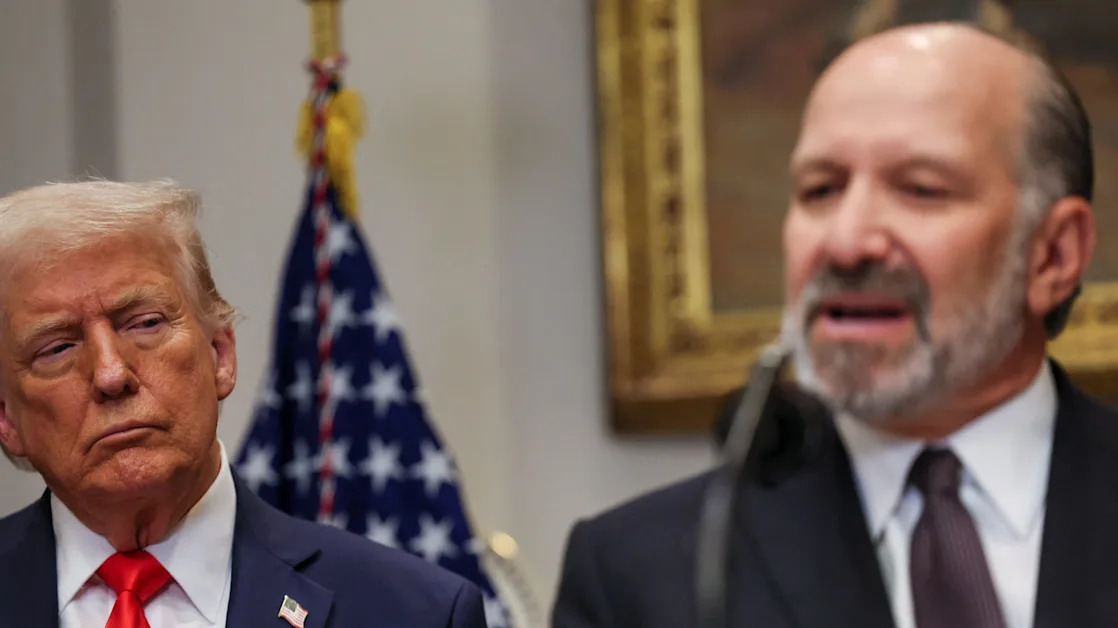
Commerce Secretary
Howard Lutnick
told Fox Business that Trump could announce tariff compromises with Canada and Mexico as early as Wednesday.
He made the comments after
US markets staggered
and closed lower for a second consecutive session on Tuesday. The S&P 500 fell 1.2%, wiping out all its gains since November’s presidential election, and the Nasdaq Composite flirted with a 10% decline from its most recent closing high before closing 0.4% lower.
Lutnick said talks with Canada would most likely reduce some of the newly reimposed tariffs on imports from the two neighboring countries.
“Both the Mexicans and the Canadians are on the phone with me all day today, trying to show that they’ll do better,” he said, adding that Trump was “listening” and open to a middle-ground solution.
Canada swiftly responded with 25% retaliatory tariffs. Ontario Premier Doug Ford said he’d cancel a $100 million deal with Starlink and remove US alcohol from shelves. He also threatened a 25% surcharge on electricity that Ontario sends to 1.5 million Americans.
Mexican President Claudia Sheinbaum meanwhile said retaliatory measures were “going to wait” because she planned to speak to Trump this week.
While details of Trump’s compromise remain unclear, Lutnick said it probably wouldn’t be another tariff pause, but a more long-term deal.
Trump spoke at length about tariffs during Tuesday’s
joint address to Congress
.
“Countless other nations charge us tremendously higher tariffs than we charge them. It’s very unfair,” he said.
Spending plans
Germany’s political leaders announced Tuesday that they’d make three big changes to the “debt brake” that has limited
government spending
since the financial crisis.
They earmarked 500 billion euros, or about 12% of GDP, for a 10-year infrastructure investment program, exempted defense spending above 1% of GDP, and reformed deficit constraints at the state level to give more flexibility to local authorities. Bank of America analysts called it a “paradigm shift” for the country’s fiscal policy.
The bump in Asian markets came after Chinese Premier Li Qiang signaled confidence in his country’s economy even amid heightened trade tensions with the US.
On Tuesday, China announced a GDP growth target of “around 5%” in a
government work report
delivered by Li at the National People’s Congress in Beijing.
China is also raising its fiscal deficit to 4% of GDP, from 3% the year before.
“Internationally, changes unseen in a century are unfolding across the world at a faster pace,” Li said in his speech at the opening of the congress.
Analysts say the economic work plan is largely in line with market expectations.
“Repeating the ‘around 5%’ growth target, despite a more challenging external environment is, in our view, a show of confidence and a harbinger of stronger policy support for domestic demand,” wrote Lynn Song, ING’s chief economist for Greater China, in a Tuesday note.
‘Buckle up’
Despite investors’ sighs of relief, Trump is probably just getting started with the trade action.
“I am confident that the bulk of the tariff developments still lie ahead. I think what we’ve seen so far is really just the beginning and I think the President is just getting started at this point,” Jeff Gerrish, the deputy US trade representative during Trump’s first term, said on a Goldman Sachs podcast uploaded on Tuesday.
Gerrish said he’d monitor the Trump-ordered US trade policy review. The reports from the review, which are expected on April 1, could lead to “a whole host of tariff actions,” Gerrish said.
On Tuesday, Trump acknowledged in his
presidential address
that tariffs could be disruptive.
“Tariffs are about making America rich again and making America great again. And it’s happening, and it will happen rather quickly,” Trump said. “There’ll be a little disturbance, but we’re OK with that. It won’t be much.”
On the same day, new US tariffs against imports from
Canada, China, and Mexico
took effect.
Canada and China
announced retaliatory tariffs in response.
Economists have warned
that additional costs from the US tariffs would most likely be passed on to American consumers rather than to foreign exporters.
Read the original article on
Business Insider
