
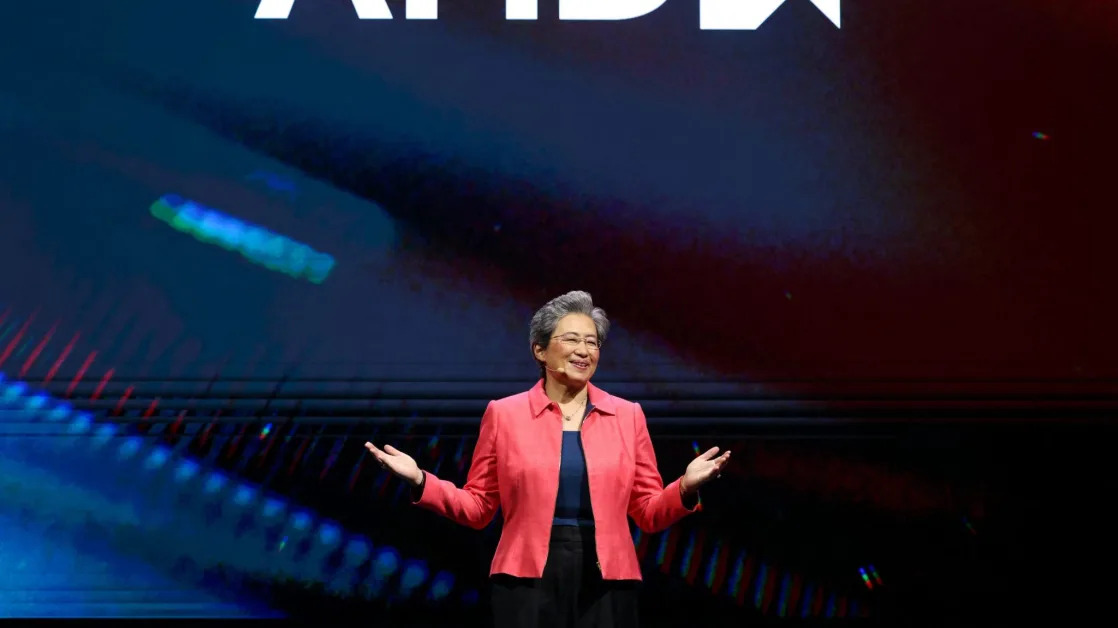
AMD shares drop as data-center sales disappoint Wall Street despite AI chip growth
AMD’s share price fell by nearly 9% in after-hours trading, after the company disappointed Wall Street with its data-center sales.
Chief executive Lisa Su’s semiconductor giant actually beat analyst estimates for overall sales and earnings, with $7.1 billion in first-quarter revenues rather than an expected $7 billion. It even reported $3.86 billion in quarterly data-center sales, representing a 69% year-on-year increase, but analysts had been hoping for $4.14 billion.
Those data-center figures represent sales of AMD’s EPYC central processing units (CPUs) and also its Instinct GPUs, which cater to the AI market. As such, these results were keenly awaited.
Nvidia
continues to utterly dominate the AI-chip sector, and
Intel
— like AMD a legacy processor manufacturer trying to win market share in the new era — just acknowledged that its
AI offerings hadn’t gained meaningful traction
and scrapped an upcoming AI chip.
AMD certainly has a better story to tell than Intel does. As Su said in an earnings call Tuesday, Meta is using AMD’s MI300X AI chips to serve its largest Llama model through its Meta AI service, and
Microsoft
is using them to power OpenAI-based Copilot services and handle other workloads.
IBM
and Dell are also offering or plan to offer AI services on the MI300X platform.
Su also claimed that the associated software, ROCm, was benefiting from recent optimizations. This is crucial for AMD as Nvidia’s lead is partly down to its Cuda software being easy for developers to use, and Nvidia’s rivals have not been able to offer a comparable experience.
“Our strategy is to establish AMD ROCm as the industry’s leading open software stack for AI, providing developers with greater choice and accelerating the pace of industry innovation,” Su said. “More than 1 million models on [the AI tool-building community] Hugging Face now run out of the box on AMD.”
Wall Street isn’t convinced. On Wednesday, BofA Securities lowered its price target for AMD from $155 to $135 while maintaining its neutral rating for the firm. Some of its peers, such as Goldman Sachs and KeyBank Capital Markets, recently
lowered their AMD price targets
on fears around its competitiveness in the AI-chip and accelerated-computing spaces.
Next generation AI chips
The big question now is what happens with AMD’s next generation of AI chips, the MI350 line, which will feature a new architecture called CDNA 4, and which targets the inference side of the AI market — that is, delivering AI services — rather than just model training. KeyBanc said last month that it expects this rollout to drive an AMD recovery, but HSBC has
been skeptical
of the platform’s competitiveness and demand.
On Tuesday, Su said CDNA 4 would “deliver the biggest generational leap in AI performance in our history, with a 35 times increase in AI compute performance compared to CDNA 3.” She cited stronger customer interest than previously anticipated, and said AMD was bringing forward production shipments to mid-year (it had previously pointed to the second half of 2025.)
AMD remains on track to launch the following generation of its data-center GPUs, dubbed MI400, in 2026, Su said.
