
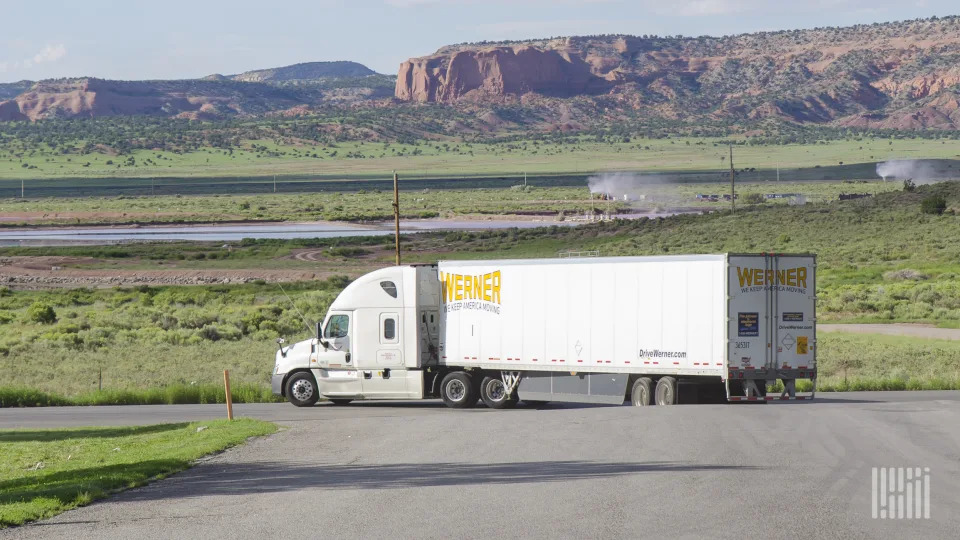
Werner CEO Leathers says freight market inflection point may be close

Werner Enterprises CEO Derek Leather several times used the term “inflection point” to describe the current freight market on Tuesday’s conference call with analysts after the company reported another in a long series of weak truckload company earnings.
But Leathers made it clear that the freight market is not at the inflection point yet. There was no clear definition of what the inflection point might look like, but he reiterated that the market had shown signs of a stabilization that could be the start of a turnaround.
“While it remains too early to call an inflection, we’re encouraged by signs of tightening,” Leathers said. “Freight demand has been steady but competitive.”
Conditions for the company’s One Way segment, which is most of the truckload operations that don’t fall under its Dedicated division, “improved midway through the quarter and continued into July.”
International Roadcheck found Werner
(NASDAQ: WERN)
experiencing a “tighter environment,” Leathers said, which is normal given how many drivers stay off the road during that enforcement crackdown period. But Leathers also said Roadcheck brought about “improving spot rates, and those gains have held.”
He noted other indicators that suggested a bottom in the market may have been reached. “We experienced more seasonal freight trends with better demand on the West Coast related to certain projects,” he said. “We expect typical seasonality leading up to peak season in the fall. Recent conversations with customers are encouraging relative to inventory levels.”
A smaller fleet
One notable statistic from the company’s earnings: Werner has cut back on the size of its fleet significantly.
In its Dedicated Truckload segment, the average number of trucks for the quarter was 4,901. A year ago, that number was 5,276, and in 2022 it was 5,184.
The One-Way Truckload segment has seen an even larger decline. Average trucks in that segment were 2,730 in the quarter, down from 3,075 a year ago and 3,102 two years ago.
Leathers said the reduction in the size of the fleet reflects the company’s “disciplined approach,” which also has seen Werner “walk away … from opportunities that we feel are not sustainably priced.”
The reduction is part of a strategy to “keep the fleet age where wanted … to prepare for
eventual emissions changes
and really have this particular fleet in a great position going forward.”
“We’re not going to spend money just to spend it,” Leathers said. “We want to make sure we’re very thoughtful with every dollar of capital allocation.” The current fleet is “sized appropriately.”
“The prolonged environment combined with our pricing and margin discipline resulted in a lower dedicated fleet size at the end of the quarter,” he said. “However, the pipeline of opportunities and dedicated lanes are strong.”
Leathers returned to the fleet reductions in his closing remarks on the call. “While fleet reductions are reality, so is the pricing discipline that drove the decrease,” he said. Werner must “achieve investable margins to justify longer-term capital commitments.”
Leathers expressed optimism in how bids for new dedicated business are playing out.
“We’re more encouraged by the quality of the bids that are in-house, the quality of the underlying customer and the fact that they view their supply chain as a strategic advantage,” Leathers said. “Those kinds of customers understand the importance of best-in-class dedicated, not just somebody that’s going to slap a logo on the side of the door.”
He returned to that theme in a separate part of the call with analysts. Werner has seen “kind of a return to value as it related to the value of trailer pools and asset-based carriers being favored slightly over brokerage by certain customers.” There is an “overarching theme” from some customers, Leathers said, about shippers “wanting to make sure that they’re prepared for what their needs may look like and for what their demand may reflect, making sure that we’re able and capable to be able to stand up and support their needs.”
Some positives in sequential data
Various financial metrics all told the story of a weak freight market that isn’t improving.
Total revenues of $760.8 million were down 6% from a year earlier. Werner’s operating income was $19.6 million, which was down 58%. Non-GAAP adjusted operating income was $21.3 million, though that also was down 58% from a year ago.
The operating margin of 2.6% was down 320 basis points from a year earlier, and the non-GAAP adjusted operating margin of 2.8% was down 350 bps.
The bottom line was a non-GAAP adjusted EPS of 17 cents per share, which SeekingAlpha reported fell short of consensus estimates by 3 cents per share.
Leathers found financial positives primarily in sequential data.
Bottom-line measures all turned up sequentially. Operating income was $19.6 million versus $15.6 million in the first quarter. Werner had an operating margin of 2.6% in the second quarter, compared to 2% in the first quarter. The non-GAAP EPS of 17 cents per share was higher than the 14 cents recorded in the first quarter.
However, not all the sequential comparisons were positive. For example, trucking revenues in the segment known as Truckload Transportation Services (TTS) net of fuel were $458.1 million in the second quarter and $469.9 million in the first.
Adjusted operating margin for TTS was 3.9% in the second quarter and 4.1% in the first.
The adjusted operating ratio in the second quarter was 95%. In the first quarter it was 95.3%, for a small improvement.
Lenders cracking down?
Leathers also said he saw signs of banks cracking down on trucking companies facing a credit crunch.
“I think lenders have been lenient to a fault, and I think you’ll see a change in that behavior as market conditions improve,” Leathers said. “I think there’s still a whole lot of people who are not going to make it out of the other end of this very dark time.”
One positive for Werner was in its prepared statement releasing the earnings. The company said it bought back 1.6 million shares during the second quarter.
Werner stock opened the second quarter at about $38 but dropped to a May 1 low of $33.12. It remained below that $38 opening mark for most of the second quarter but closed Tuesday at $40.44. Werner said it had made the acquisitions “opportunistically,” and it appears that all of the shares it purchased are now valued at more than their acquisition price.
More articles by John Kingston
Ryder, reporting sluggish earnings growth, sees ‘trough’ in freight market
Backed by big companies and labor, Supply Chain Council debuts
Victory for a 3PL again — TQL — in case involving broker liability
The post
Werner CEO Leathers says freight market inflection point may be close
appeared first on
FreightWaves
.
