
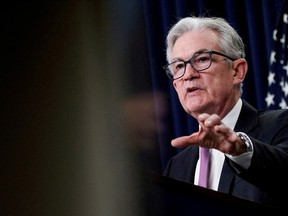
The Federal Reserve has raised interest rates once again, signaling that further increases are planned as part of efforts to combat inflation.
The U.S. Federal Reserve has delivered a significant and, arguably, forceful response to persistent inflation, raising its benchmark interest rate by 75 basis points for the third consecutive time. This move, exceeding many investor expectations, signals the Fed’s unwavering commitment to curbing rising prices, even if it increases the risk of a recession. Fed Chair Jerome Powell emphasized the urgency, stating, “We have got to get inflation behind us,” and underscored that the path forward, regardless of the pain it may cause, is essential to prevent a more damaging return to price instability down the road.
The decision to increase rates to a range of three per cent to 3.25 per cent reflects the Fed’s acknowledgement of the complex challenges in balancing the need to cool the economy with the risk of over-tightening and pushing the U.S. into a recession. Projections for future interest rates, forecasting peaks at 4.4 per cent by the end of this year and 4.6 per cent in 2023, indicate a continued, albeit potentially fluctuating, course of aggressive tightening. This strategy aligns with the Fed’s determination to meet its two-percent inflation target, a target that has proven elusive despite the central bank’s efforts.
The Fed’s revised forecasts paint a picture of a slowing economy. Estimates for economic growth in 2023 have been reduced to 1.2 per cent and 1.7 per cent in 2024, reflecting the anticipated impact of higher borrowing costs. Furthermore, the Fed anticipates rising unemployment, forecasting levels of 4.4 per cent by the end of next year and remaining at 4.1 percent in 2024. These projections are partially influenced by robust labour market figures and the resistance of the job market to soften which has provided further support for the decision to raise rates.
The intensity of the Fed’s response is being viewed as unprecedented in recent history, comparing favorably to the approach of former Fed Chairman Paul Volcker during the early 1980s. Officials and economists alike have noted that this represents the most aggressive monetary policy stance since Volcker’s tenure, and the move underscores the seriousness with which the Fed is treating the issue of inflation. The collective action of central banks globally, with over ninety hiking interest rates this year, is also contributing to the environment, suggesting a coordinated effort to combat inflationary pressures.
Several economists have expressed caution regarding the potential for a recession, given the Fed’s increasingly hawkish stance. Derek Tang, an economist at LH Meyer, described the Fed’s actions as “Powell’s last roll of the dice,” suggesting a significant commitment to achieving inflation control regardless of the economic consequences. The potential for significantly higher unemployment rates adds another layer of concern. This is not simply a matter of adjusting interest rates; it is a deliberate and forceful intervention intended to reshape the economic landscape.
The inflationary environment remains stubbornly persistent, failing to slow down as quickly as the Fed had hoped. While inflation peaked at 9.1 percent in June, it remained at 8.3 percent in August, indicating a slower pace of decline. The robust labor market continues to resist a softening, a dynamic which has added to the urgency of the Fed’s response. The commitment to bring this inflation back to two percent is unwavering.
Looking ahead, the Fed is signaling a continued tightening path, although the precise timing and magnitude of future rate hikes remain subject to ongoing assessment. The environment of global monetary policy tightening, with central banks around the world raising interest rates, adds to the challenges and uncertainties. As the U.S. economy moves into 2023, the actions of the Federal Reserve will be closely scrutinized, and the outcome will largely determine the country’s economic trajectory.
