
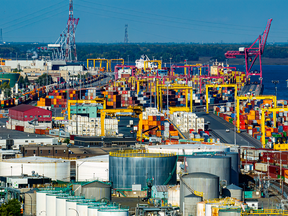
Port Strikes Disrupt North American Economy: What You Need to Know
The disruptions stemming from simultaneous strikes by dockworkers at the Port of Montreal and across the U.S. East and Gulf Coasts are sending considerable ripples throughout North American economies. Denise Paglinawan, in a Financial Post article, delves into the specifics of these work stoppages and assesses their potential ramifications for both Canada and the United States.
Port Strikes Trigger Economic Uncertainty
The situation began with a three-day strike initiated by dockworkers at the Port of Montreal, encompassing the Viau and Maisonneuve terminals, operated by Termont Montreal Inc., commencing on September 30th. The Maritime Employers Association, representing the maritime transportation industry in Quebec and Ontario, cited unsuccessful mediated contract negotiations as the reason for the strike’s commencement. Over 1,200 Montreal longshoremen, represented by the Montreal Longshoremen’s Union, and approximately 47,000 members of the International Longshoremen’s Association (ILA) are currently on strike. This coordinated action is halting operations at key coastal gateways, from Houston to Miami and New York/New Jersey, the nation’s busiest Atlantic commerce hub.
Key Demands and Negotiating Points
The underlying causes of these strikes are centered around worker demands. Montreal dockworkers, after rejecting their employer’s initial offer in 2021 – a dispute which was ultimately resolved by federal arbitration and mandated return-to-work orders – are seeking annual wage increases of 20 percent to keep pace with inflation and a more balanced work-life balance. Simultaneously, U.S. longshore workers are demanding a significantly higher wage increase of 77 percent, or $5 per hour for each of the six years of their proposed new contract with United States Maritime Alliance (USMX), representing foreign-owned ocean carriers and terminal operators. The ILA argues that these demands reflect the “crippling” impact of inflation, while USMX asserts that these increases are necessary to address rising operational costs. Crucially, both sides are embroiled in a debate surrounding automation, with the longshoremen seeking a firm ban on potentially job-reducing automation of cranes, gates, and container movements.
Impact Across North American Economies
The consequences of these strikes are far-reaching. The Port of Montreal handles 41 percent of container traffic at Canada’s second-largest port. Its shutdown is depriving companies in Quebec and Canada of this handling capacity during a crucial time for holiday cargo transit, potentially costing the region $90.7 million in economic activity per day. The U.S. East and Gulf Coast ports, collectively responsible for 57 percent of U.S. container volume, are also experiencing significant disruption. The ILA estimates that a week-long strike cost the U.S. economy $3.78 billion, while Oxford Economics projects a reduction of U.S. GDP by $4.5 to $7.5 billion. The disruption is particularly pronounced in key industries, including raw materials processing, tobacco/nicotine distribution (with approximately 80 percent of trade affected), and auto manufacturing, potentially creating shortages or delaying shipments. TD economist Admir Kolaj notes that the impact extends beyond the transportation sector, directly affecting retail and manufacturing operations.
Economic Modeling and Forecasts
Several organizations have developed economic forecasts based on the ongoing strikes. The Conference Board estimates a $3.78 billion loss for the U.S. economy per week, while Oxford Economics projects a U.S. GDP reduction of $4.5 to $7.5 billion annualized. These figures highlight the immense scale of the disruption and underscore the fragility of North America’s supply chains. The Maritime Employers Association emphasizes that the labor disputes are not just impacting Quebec and Canada, but also damaging Canada’s reputation as a reliable trading partner, particularly as the country grapples with a shortage of skilled workers.
Conclusion
The concurrent strikes at the Port of Montreal and along the U.S. East and Gulf Coasts represent a significant challenge to North American trade. The disputes, driven by competing demands for increased wages, automation bans, and a better work-life balance, are generating substantial economic losses and highlighting vulnerabilities within supply chains. As negotiations continue, the outcome will undoubtedly have long-lasting implications for businesses, consumers, and the overall stability of the continent’s commercial network.
