
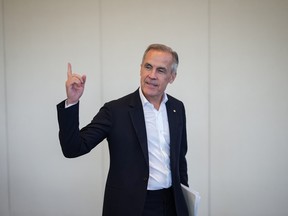
Poilievre Attacks Carney’s Advice to Trudeau on Economy
Pierre Poilievre, the leader of the Conservative Party and the current frontrunner in polls for the upcoming federal election, is increasingly scrutinizing the relationship between former Bank of Canada Governor Mark Carney and Prime Minister Justin Trudeau’s Liberal government. The central point of contention revolves around Carney’s recent advisory role in shaping economic policy for the Liberal Party, particularly in the lead-up to the 2025 election. Critics, primarily Poilievre, argue this arrangement raises concerns about potential conflicts of interest.
The Conservative leader alleges that Carney is essentially wielding undue influence over the government’s economic strategy, gaining significant power and financial benefits without the accountability typically associated with a government position. Poilievre frequently refers to Carney as "Carbon Tax Carney," a pointed jab at the Liberal government’s national carbon tax program, which Poilievre has pledged to eliminate if elected. This rhetoric highlights a broader critique of Carney’s involvement as a perceived attempt to manipulate policy for partisan gain.
Carney’s role has become particularly pronounced as he advises the Liberal Party on strategies for economic recovery and growth. He’s been engaged in discussions regarding productivity, offering insights in anticipation of the upcoming campaign. This intervention is significant given Carney’s past experience as Governor of the Bank of Canada and, subsequently, the Bank of England. His presence and advice have sparked debate regarding the propriety of a prominent financial figure advising a political party, especially considering his significant business interests.
The scrutiny of Carney’s connections extends beyond the carbon tax issue. Poilievre has focused on Brookfield Asset Management, the global investment firm where Carney currently holds a leading position, and the firm’s investments, particularly those involving fossil fuel projects, which contrast sharply with the Liberal government’s climate change commitments. This comparison underscores Poilievre’s strategy of exposing potential conflicts of interest and framing Carney as aligned with corporate interests rather than public policy.
Furthermore, Poilievre has highlighted Brookfield’s influence and connections within the Chinese economy, raising concerns about potential national security implications. This line of attack suggests an overall assessment that Carney is prioritizing financial interests and business relationships over broader Canadian values and policy objectives.
Carney’s engagement with the Liberal Party is part of a broader effort to influence economic policy. He has publicly supported the government’s carbon tax, albeit with a qualification that it has “served a purpose up until now,” and stressed the need for a “credible and predictable” alternative should the Conservatives take power. This stance reflects Carney’s pragmatic approach, viewing the carbon tax as a necessary tool in the transition to a green economy, while simultaneously offering a roadmap for its potential elimination.
Following his departure from the Bank of England in 2020, Carney returned to Canada and has been a visible presence at various Liberal events, including a recent gathering of elected members of parliament. There have been reports suggesting that Trudeau has actively sought Carney’s involvement in politics, with speculation that Carney could potentially become Canada’s next finance minister. Chrystia Freeland, currently holding that role, has dismissed these claims of a rift between her and Trudeau.
Historically, Poilievre has demonstrated a willingness to target prominent Liberal figures due to their business connections, most notably taking aim at Bill Morneau, Trudeau’s first finance minister, over his family’s involvement in financial services. The scrutiny of Carney mirrors this approach, emphasizing the importance of transparency and accountability in government and questioning the influence of corporate interests within political decision-making processes.
The Conservative leader’s attacks on Carney are likely to intensify as the 2025 election approaches, presenting a key challenge for the Liberal government. The underlying narrative centers on concerns about influence, accountability, and potential conflicts of interest, strategically employed as a central element of Poilievre’s campaign.
With Carney’s background encompassing leadership roles at two major central banks and his current position as a global investment strategist, the tensions surrounding his involvement with the Liberal government are further complicated. This dynamic raises fundamental questions about the boundaries between finance, politics, and the overarching pursuit of economic policy.
Recent reports indicate that Brookfield Asset Management and its investment decisions, including its activities in international fossil fuel projects, are attracting increased attention from political opponents. While neither Carney nor Brookfield have issued immediate responses to the criticism, the scrutiny signals a key battleground in the upcoming election.
Political analysts suggest that Poilievre’s strategy of focusing on Carney’s connections is a deliberate effort to undermine public confidence in the government’s economic policies and highlight potential flaws in the decision-making process. This tactic is anticipated to resonate with voters concerned about transparency and accountability in government, representing a key strategic element in Poilievre’s campaign.
