
Busting the Myth of 2021’s Record Market Returns!
2021’s Economic Performance Review: Key Metrics and Insights
As the year 2021 comes to a close, traders, investors, and portfolio managers are evaluating their performance in comparison to broader stock market indexes. The key questions they are asking themselves include: how did they perform compared to the inflation target set by the Fed? How did they navigate the potholes and landmines of bad trades and investment decisions?
Recap of Economic Metrics for 2021
One of the most critical metrics to constantly monitor is the Consumer Price Index (CPI), which shows a 6.8% inflationary growth rate in the 4th quarter alone. This means that investors and traders need to achieve at least 6.8% return on their portfolios just to break even, after accounting for the loss of purchasing power.
Money Supply Growth: A Key Metric
Another crucial metric is Money Supply growth, which measures the amount of dollars added to the economy. In 2021, M2 grew by over 12%, indicating a potential increase in future inflation rates if those additional dollars do not produce new economic growth.
A thought exercise to assume a worst-case scenario where 12% more money becomes a baseline inflation risk can help plan finances accordingly. This consideration highlights that investors and traders need at least 12% growth in their investments just to maintain purchasing power, should the economy experience such an outcome.
Federal Reserve Balance Sheet Overview
In 2021, the Fed purchased $120 billion of Treasury Bonds per month, along with corporate and junk bond debt, to support the economy. The Federal Reserve’s balance sheet grew by 14.8% from $7.324 trillion in December 2020 to $8.4 trillion today.
This growth becomes important as the Fed plans to taper its bond purchases within the next 4 months and raise interest rates three times in 2022. Historically, long-term readers of this blog have cautioned against interest rate manipulation’s malignancy on the economy.
Currently, the 10-year Treasury Note yields 1.539%, resulting in a negative yield when paired with an inflation rate of 6.8% (-5.261%). This metric explains why savers are entering the stock market to chase yield and return, causing a melt-up in financial assets.
Navigating Interest Rate Increases: The Financial Market Implications
The uncertainty around whether the Fed can raise interest rates effectively is substantial. Three planned rate increases for 2022 and two additional raises in 2023 will exponentially increase the cost of servicing government debt moving forward. This consideration underscores how a 33% increase in interest expenses can affect personal finance, echoing concerns when mortgage or credit card interest rates rise.
Assessing Market Performance: Broader Stock Market Indexes
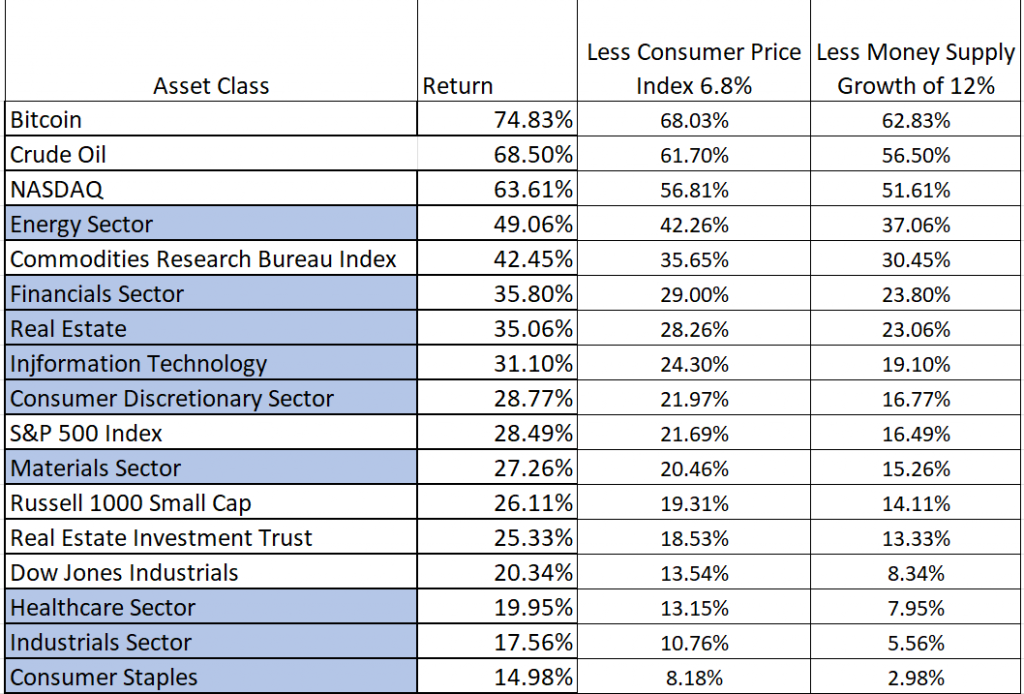
The performance of mainstream stock market indexes such as the NASDAQ (+63.61%), S&P 500 index (+28.49%), Russell 1000 Small Cap (26.11%), and Dow Jones Industrials (20.34%) reveal the complex economic environment faced by investors.
However, when evaluating real rates of return considering inflation (6.8% CPI) and Money Supply growth metrics, a different story emerges, underscoring the need for careful financial planning to protect purchasing power in 2022.
Navigating Uncertainty: Opportunities in Cryptocurrency
The most resilient asset class in 2021 has been Bitcoin, maintaining an impressive performance despite high volatility. Its rate of return is significantly higher than that of broader stock market indexes, particularly when one considers the massive return (426%) experienced by Ethereum, the second largest cryptocurrency.
Ethereum’s performance further highlights its importance as a foundational element for decentralized finance and smart contracts within the cryptocosm.
Maintaining Purchasing Power in an Uncertain Market
Retirees traditionally purchase U.S. government bonds to secure income at 5%, which would yield $50,000 per year on a one million dollar investment. However, with inflation rates at 6.8% and bond yields at 1.5%, this strategy has been rendered unrealistic, vaporizing what was once considered a reliable means of investing for the future.
A Race to Debase: Implications for Financial Markets
The current economic environment is increasingly forcing traders into shorter time frames as everyone searches for yield, pushing asset prices upwards. With cheap capital flooding the market and an economy still reliant on monetary stimulus handed out by the Federal Reserve, navigating financial uncertainty becomes a more daunting task.
Protecting Purchasing Power with Artificial Intelligence
Traders and investors seeking to protect their purchasing power in 2022 may consider integrating advanced pattern recognition tools or machine learning strategies, which have proven capable of accurately predicting trends. A.I. forecasts can alert you to high probability trend developments as they emerge, allowing for informed investment decisions.
The goal is not magic but to apply data-driven insights that align with real-world economic factors, ensuring a more secure financial future in the face of escalating uncertainty.
Disclaimer and Important Notice
Trading in stocks, futures, options, Forex, ETFs, and cryptocurrencies involves a substantial risk of loss. Only utilize risk capital for trading activities to avoid significant personal financial losses.
