
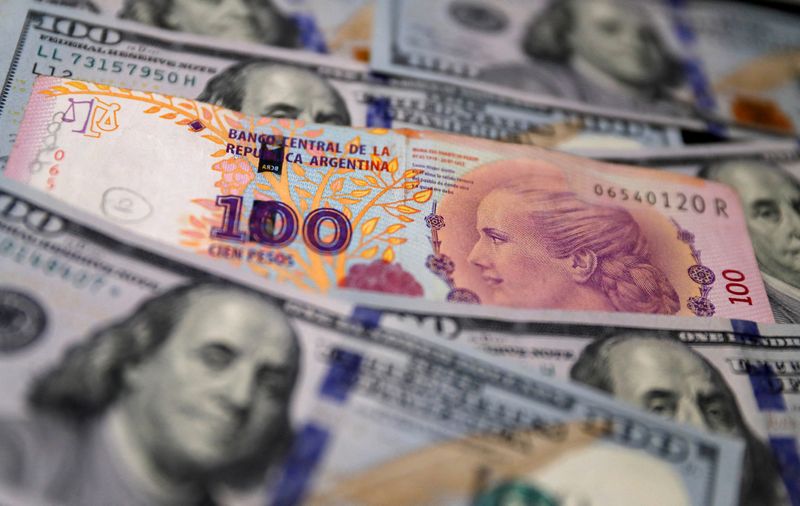
Argentina Peso Futures Plunge as Traders Speculate on IMF Deal
Argentina’s Currency Under Scrutiny: Traders Guess at Exchange Rate Regime Ahead of IMF Deal
Argentina’s currency, the peso, has been on a wild ride in recent weeks as traders weigh the likelihood of a faster depreciation following the International Monetary Fund’s (IMF) announcement of a staff-level agreement with Argentina. The April peso future contract has weakened significantly, sparking uncertainty and divided opinions among analysts.
The IMF deal is expected to bolster depleted reserves, but what does this mean for the exchange rate regime? Traders are playing a guessing game, with some predicting devaluation, while others rule it out entirely. President Javier Milei, known for his libertarian views, has long advocated for unwinding currency controls in place since 2019.
Uncertainty Reigns Ahead of IMF Loan Program Approval
The government has moved to quash speculation about a sharp devaluation, but the IMF’s proposed agreement does not provide clear answers. Analysts are divided on what might transpire with exchange rate policy, with some predicting a devaluation within limits and others ruling it out altogether.
The IMF loan program is expected to go before the board for approval on Friday, further unsettling traders. Meanwhile, analysts at Cohen, an Argentina-based settlement and clearing agency, point to uncertainty surrounding the signing of the agreement with the IMF as a key factor contributing to the surge in dollar futures contracts.
Argentina’s Currency Controls: A Key Factor in Uncertainty
Currency controls have been a subject of debate for years in Argentina. Milei, who has long advocated for their removal, may finally get his wish. The current crawling peg, which permits a monthly depreciation rate of 1%, has helped stabilize the currency, but some analysts argue that it is merely delaying the inevitable crash.
Argentina’s economy has faced significant challenges since 2019, with inflation running rampant and reserves dwindling. The IMF loan program aims to alleviate these pressures by replenishing depleted resources. However, the future exchange rate regime remains cloudy, leaving traders to guess at its implications for the peso.
Argentina’s Economy: A History of Currency Turmoil
Argentina has a long history of currency turmoil, with frequent devaluations and sharp depreciations in the past. The current crawling peg is seen by many as an attempt to stabilize the economy, but it comes with its own set of challenges.
In 2018, Argentina faced a major economic crisis under President Mauricio Macri, which ultimately led to his ouster. His successor, Alberto Fernández, inherited a nation on the brink of disaster and implemented stricter capital controls in response to dwindling reserves.
Possible Scenarios: A Devaluation, Currency Band, or something else?
Devaluation is one possible outcome that has many analysts speculating about the potential impact on Argentina’s currency. However, some predict that Milei will ultimately opt for a more drastic change – abandoning the crawling peg and implementing an outright currency band.
A currency band would limit depreciation to a specific range while still allowing flexibility in exchange rates. While it might mitigate short-term risks, many analysts argue that such a measure is unlikely without first eliminating strict capital controls.
Impact on Argentine Peso Futures
Argentina’s peso has suffered recently as traders become increasingly uncertain about the direction of the economy under new leadership. As news broke of the IMF deal and its expected approval by the board, markets reacted cautiously.
While there are no definitive predictions yet for the full outcome of these negotiations, it appears clear that further depreciation is on the horizon in some capacity or another – fueling concerns among traders about what may happen first.
