
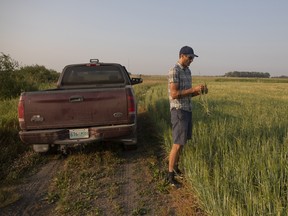
Farmers are converting crops into cattle feed due to the severe drought.
The relentless grip of drought is transforming agricultural landscapes across both the United States and Canada, forcing farmers to make a drastic and rarely seen decision: converting their cereal crops—wheat and barley—into hay to sustain livestock. This unfolding situation, exacerbated by soaring feed costs and predicted high temperatures, highlights a critical challenge for food production and underscores the profound impact of shifting weather patterns. Farmers are facing an unprecedented convergence of challenges, prompting urgent action from governments and agricultural organizations.
The core of the issue lies in the widespread baling of crop stems—typically intended as grain—into hay, a direct consequence of the severely diminished pastureland and dwindling forage options. This shift also signals the potential for reduced grain harvests, a factor contributing to anticipated price increases for crops. Next week’s forecast of soaring temperatures in the Great Plains further intensifies the crisis, threatening already parched fields and raising serious concerns about future yields. The situation calls for an immediate, multi-faceted response to avert widespread livestock losses and ensure food security.
The impact is particularly pronounced in North Dakota, where the entire state is experiencing a prolonged drought. Hay crops have dwindled to just 10 to 25 percent of normal levels, while ranchers are actively reducing their herds through increased sales at auction. Jeff Schafer, president of the North Dakota Stockmen’s Association, explained that prioritizing hay production from small grain fields over harvesting for grain is the only viable option given the scarcity of feed. “Producers have chosen to cut small grain fields for hay versus harvesting them for grain as there just isn’t enough forage to bale,” Schafer stated during a National Oceanic and Atmospheric Administration webinar. Fields, often described as “boot-high at best and typically you can see a gopher run in front of your cutter bar,” had not yielded the anticipated “armpit high” harvests, and many were marked by stunted growth and uneven seedings due to the lack of moisture. Farmers are working with limited grass, growing in June due to the scarcity of rain.
Contributing to this crisis are aberrations in the bands of westerly winds known as jet streams—high-altitude air currents. These shifts in the jet stream have played a significant role in creating drought conditions in the West and fueling record rainfall and flooding in Europe. The impact on North American agriculture is a stark reminder of the interconnectedness of global weather systems. Facing significant uncertainty about their harvests, Agricultural and Agri-Food Canada recently revised its principal field crop production estimates, acknowledging the “significant uncertainty” surrounding yield predictions due to the prevailing hot and dry conditions. The situation is further complicated by the need to expedite crop insurance assessments to allow farmers to sell low-yielding crops as feed while the opportunity remains.
In the Canadian Prairies – affectionately known as the nation’s “bread basket” – the extreme heat wave combined with prolonged dryness has reduced pasture and hay growth, forcing some farmers to convert their drought-damaged cereal crops (primarily wheat) into animal feed. This action is vital to maintaining livestock herds. The Canadian Cattlemen’s Association is urging crop insurance programs to take immediate action to assess withering fields earlier than usual, so grain farmers who want to sell their crops as animal feed can do so while the opportunity still exists. A top priority for beef producers is to maintain the cattle herd by working with grain and oilseed farmers to convert failed crops into suitable feed, while that opportunity still exists. The agricultural sector is actively engaged in finding solutions to mitigate the impact of this unprecedented challenge.
The situation is underscored by government intervention. Agriculture and Agri-Food Canada reduced its principal field crop production estimates slightly on Tuesday, but said the hot and dry conditions are causing “significant uncertainty” in estimating yields during the growing season. Further complicating matters, the government amended its crop insurance program earlier this month to encourage farmers to sell low-yielding crops as feed, driven by the severe shortage. Doug Goehring, North Dakota’s agriculture commissioner, emphasized the critical need to marshal every available resource to prevent livestock losses. “In order for our livestock producers to make it through this disaster, it is necessary to marshal every available resource,” Goehring said, requesting the U.S. Department of Agriculture to allow for grazing. The combination of government action and industry initiatives highlights the urgency with which this crisis is being addressed.
Looking ahead, the forecast is not promising. While scattered rains have moved through the area, bringing spring wheat futures down from the highest levels since 2012, Ryan Truchelut, president of Weather Tiger LLC, anticipates that temperatures will soar into the mid-to-upper 90-degree Fahrenheit range across the northern Great Plains next week. “That means yields for crops such as corn are in ‘significant trouble at this point,’" Truchelut stated. The implications for agricultural output are substantial, signaling a potentially challenging season for grain production. The crisis underscores the vulnerability of the agricultural sector to extreme weather events and the critical need for investments in climate resilience and adaptation strategies.
Bloomberg.com shares the story.
Concluding, the drought’s impact on North American agriculture represents a critical juncture, demanding immediate and coordinated action to safeguard livestock populations, stabilize food supply chains, and invest in resilient agricultural practices for the future.
