
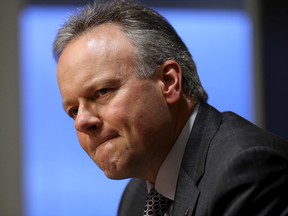
Poloz Predicts Decade of Rising Market Volatility
Stephen Poloz, the former Governor of the Bank of Canada who stepped down in 2020, has released a new book, “The Next Age of Uncertainty: How the world can adapt to a riskier future.” In the book, Poloz lays out his perspective on a decade marked by escalating volatility, driven by a convergence of significant global challenges. Poloz, now serving as a special advisor at the law firm Osler, Hoskin & Harcourt LLP and holding a corporate director role, argues that political systems are currently ill-equipped to handle the complex crises that lie ahead. He specifically identifies five “tectonic” forces — an aging population, rapid technological advancements, widening income inequality, increasing levels of government and corporate debt, and the accelerating impacts of climate change — as interacting beneath the surface and poised to generate new waves of instability for at least the next decade. These forces, he contends, will necessitate a fundamental shift in how societies and economies respond to crises.
Poloz’s analysis centers on the intricate interplay between these factors. A key element of his argument revolves around the energy transition, which he sees as a significant driver of inflation and interest rate pressures. The transition also presents unique challenges, including potential disruptions to supply chains and the need for substantial investments in renewable energy infrastructure. Furthermore, Poloz highlights the likely scenario where employees gain a competitive advantage over employers due to evolving skill sets and changing workforce dynamics, impacting labor markets and economic structures. The discussion extends to addressing the broader macroeconomic environment, including the effects of rising interest rates and their potential impact on global growth.
To understand Poloz’s forecasts, it’s vital to consider the scope of his concerns. He predicts that these “tectonic” forces won’t simply create isolated shocks; rather, they will interact in unpredictable ways. The accelerating pace of technological innovation, for instance, will further complicate the situation, demanding continuous adaptation and potentially exacerbating existing inequalities. Poloz believes that this scenario requires a proactive and innovative approach to risk management, moving beyond traditional responses focused solely on short-term economic indicators. He stresses that a deeper understanding of these interconnected forces is crucial for developing effective strategies.
Poloz emphasizes the need for a fundamental re-evaluation of how nations and organizations address systemic risks. To gain a comprehensive understanding of his viewpoint, listeners can find Poloz discussing these issues in detail through various platforms. The ideas and analyses are available via podcasts on Apple Podcasts, Spotify, Stitcher, and YouTube. Here, audiences can subscribe for weekly episodes delivered every Wednesday morning. Individuals with questions about the show or topics they’d like the team to explore can contact the team directly at [email protected], or via email to [email protected], additionally through Twitter at GabeFriedz.
The discussion regarding Poloz’s outlook is easily accessible and actively promoted via various channels. Specifically, the podcast episodes can be accessed via Apple Podcasts, Spotify, Stitcher and YouTube. Furthermore, listeners can subscribe for weekly episodes delivered every Wednesday morning. Additionally, those with questions about the show or topics they’d like the team to tackle can contact the team directly at [email protected], or via email to [email protected], additionally through Twitter at GabeFriedz. Poloz’s insights are readily available to a wide audience, encouraging a broader conversation on navigating the challenges of a volatile and uncertain future.
