
Saudi Oil Attack Halts Half Production, Fuels $100 Oil Fears
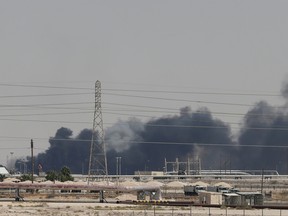
Saudi Arabia’s return to its full oil production capacity after Saturday’s attacks on Aramco oil plants is now expected to take “weeks, not days,” according to a source close to the matter, as revealed on Sunday. The attacks, targeting Abqaiq and Khurais, resulted in the disruption of approximately 5.7 million barrels per day (bpd) of the kingdom’s output, and Saudi officials had not provided a timeline for restoring full production capabilities. The situation has significantly raised concerns about potential increases in global oil prices, potentially reaching $100 a barrel.
The attacks, which involved a drone strike by Yemen’s Houthi rebels, caused fires and severely hampered Saudi Arabia’s oil supply – representing roughly half of its total production and roughly 5% of global oil supply. This disruption has immediately spurred debate about potential geopolitical impacts and the future of energy markets. The attacks marked a significant escalation in tensions within the Middle East, with experts highlighting the increased risk of regional conflict and further price volatility.
The disruption to Saudi Arabia’s oil production threatens to destabilize global energy markets. Analysts estimate the attacks could drive Brent crude futures upwards by $5-$10 per barrel in the short term, potentially surging to $100 per barrel if full production isn’t restored quickly. This scenario is further complicated by heightened geopolitical risks, with various market participants anticipating potential ‘premiums’ to factor in risk and address supply concerns.
The immediate blame has been placed squarely on Iran, according to U.S. Secretary of State Mike Pompeo, who asserted there were "no evidence the attacks came from Yemen." This accusation has intensified existing tensions between the U.S. and Iran, further complicating the already delicate situation in Yemen, where the Houthi rebels have been engaged in a protracted conflict with a Saudi-led coalition. The attacks underscore the vulnerability of critical energy infrastructure to asymmetric warfare and represent a serious escalation in regional security risks.
Experts predict a rapid response from the global energy markets, with Brent futures anticipated to rise by $2-$5 per barrel in the short term. Concerns about supply availability and increased risk premiums are expected to dominate trading activity. Market participants recognize the attacks as a potentially irreversible shift in the risk landscape for Gulf oil production.
Several analysts have offered their assessments of the situation. Bob McNally of Rapidan Energy stated that a disruption lasting two weeks would see crude prices rise by $15-$20 per barrel, while Greg Newman of Onyx Commodities anticipates prices could climb to $7-$10 per barrel if the disruption expands beyond a few weeks. Ayham Kamel of Eurasia Group warned that the attacks represent a “seismic change” and could lead to a review of the risk premium applied to Gulf oil production.
The long-term implications of the attacks are considerable. For Asian governments, the situation has prompted a reassessment of reliance on Gulf oil production. Analysts believe the volatility could accelerate support for U.S. sanctions against Iran, as governments seek to secure alternative energy supplies. Beyond immediate price impacts, the attacks underscore the increasing vulnerability of critical infrastructure to non-state actors and the potential for escalation in already complex geopolitical environments. The disruption is likely to accelerate preparations for “worst-case” scenarios, pushing governments and businesses to enhance their resilience to future threats.
