
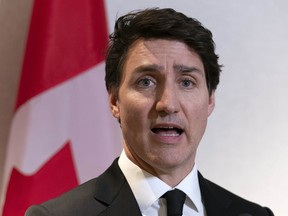
Trudeau Warns Canada Ready for Trade War Response from Trump
Canada is preparing a multifaceted response to potential trade actions by the incoming U.S. administration under President-elect Donald Trump, primarily focused on safeguarding its robust economic relationship with the United States. Prime Minister Justin Trudeau, speaking on MSNBC’s “Inside with Jen Psaki,” stated that Canada is ready to retaliate with tariffs if the U.S. initiates a trade war, emphasizing the importance of maintaining the current trade dynamic. This proactive stance reflects a deep understanding of the significant interconnectedness between the two nations, particularly given Canada’s position as the number one export partner to approximately 35 different U.S. states.
The Canadian government’s preparations are rooted in the considerable volume of trade between the two countries. Approximately $320 billion in U.S.-made goods were imported into Canada during the first eleven months of last year, reflecting a deeply integrated economic partnership. The trade deficit with the U.S. reached $55 billion during that same period, highlighting the substantial economic reliance on exports to the American market. Trudeau underscored that disruptions to this established trade flow would ultimately negatively impact American citizens and American jobs, a key element in the Canadian strategy.
The Canadian government’s response to President-elect Trump’s initial threats regarding tariffs on steel and aluminum in 2018 involved swiftly imposing levies on a range of U.S.-manufactured items, including household appliances, bourbon whiskey, and boats. The current situation represents a continuation of this approach, with preliminary plans circulating within the Canadian government outlining a potential strategy to affect nearly every category of products entering Canada from the U.S. This proactive measure, detailed on Jan. 10 by Bloomberg, demonstrates Canada’s determination to defend its economic interests.
Beyond simply imposing tariffs, the Canadian government is taking a more comprehensive approach to bolster its national security amidst concerns about potential tensions. Prime Minister Trudeau has announced increased spending on border security, including the acquisition of more helicopters and drones, aimed at mitigating the flow of illegal migrants and fentanyl – a critical issue highlighted by President-elect Trump. Data reveals that less than one percent of illegal migrants and fentanyl entering the United States originate from Canada, a point Trudeau emphasized. The investment of approximately $2 billion aims to further strengthen border security, reinforcing a commitment to address security concerns while safeguarding the economic relationship.
The Canadian government’s strategy extends to engaging directly with the incoming U.S. administration. Prime Minister Trudeau, who will step down after leading the Liberal Party through the next leadership contest on March 9th, has scheduled a meeting with President-elect Trump at Mar-a-Lago in Florida. The meeting, focused on the crucial U.S.-Canadian energy relationship, is being facilitated by Alberta Premier Danielle Smith. Moreover, Canadian provincial premiers intend to visit Washington D.C. in February to voice their concerns about the potential economic harm resulting from tariffs. Ontario Premier Doug Ford previously suggested imposing a 25% tariff on electricity exports to several U.S. states, but has since proposed a new energy partnership involving the delivery of nuclear power to the U.S.
The situation is further complicated by internal political dynamics within Canada. Finance Minister Chrystia Freeland resigned in December, citing the need to avoid “costly political gimmicks” and maintain financial stability in the face of a potential trade war. This abrupt departure created an upheaval within the Liberal Party, triggering calls for Prime Minister Trudeau to resign. The next leadership contest will determine Canada’s future political direction, with a national election scheduled for October – a timeline that could be accelerated if opposition parties attempt to force a vote of no confidence.
The stakes are undeniably high. Canada’s economic future, and its relationship with arguably its most significant trading partner, hang in the balance. The Canadian government’s willingness to employ a combination of defensive measures – including reciprocal tariffs, targeted investments in border security, and direct engagement with the incoming U.S. administration – underscores a firm commitment to protecting its economic interests while navigating a potentially turbulent global trade environment. Sources, including Bloomberg, continue to monitor the situation closely, acknowledging the far-reaching implications of the potential trade war.
