
US Debt Bubble Bursts: Who’s Next in Line?
Summary
In this article, we dive into a fascinating chart of the U.S. Treasury Note market and explore its implications for investing and trading. With a focus on understanding the underlying dynamics and trends, we break down the reasoning behind our analysis and provide insights into the current economic landscape. We examine the recent debt ceiling negotiations and their impact on the economy, discuss the relationship between government spending and private investment, and highlight the emergence of BRICS nations as credible alternatives to Western economies. Throughout the article, we emphasize the importance of recognizing the "toxic" nature of U.S. Treasury assets in a rising interest rate environment.
The Rabbit-Hole Effect: Exploring the U.S. Treasury Note Market
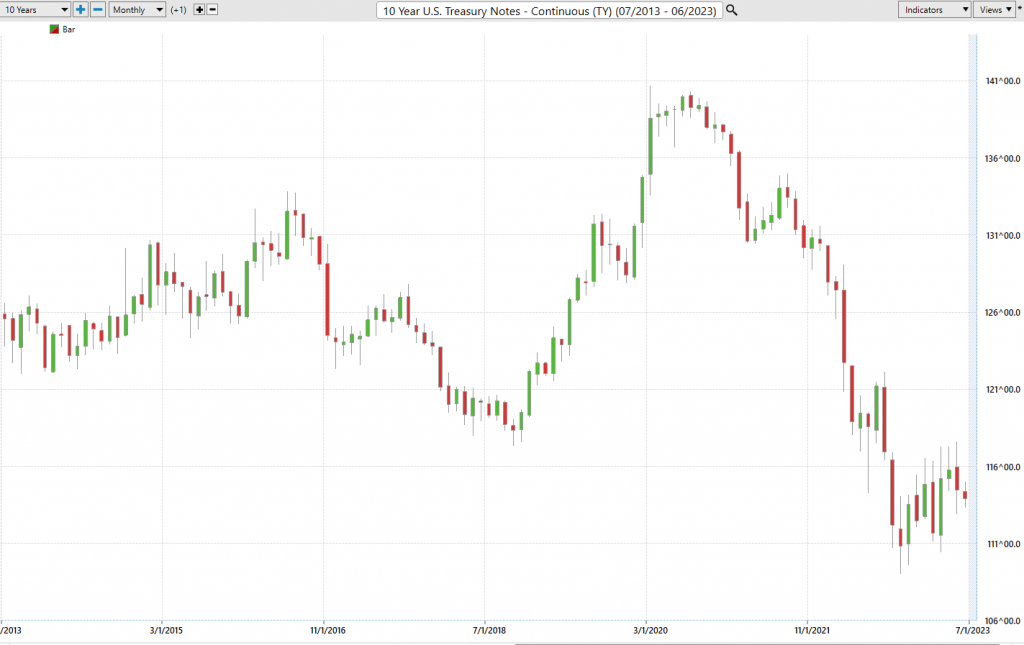
One of the fascinating things that occurs to me quite regularly is the rabbit-hole effect of delving into complex economic charts and data sets. Recently, I found myself enticed by a chart of the U.S. Treasury Note market, which has significant implications for investing and trading. This particular chart depicted the fluctuations in the bond’s price over time, with noticeable trends emerging. At first glance, it appears to be a benign representation of market sentiment; however, upon closer inspection, subtle patterns begin to emerge that warrant further examination.
The Recent Debt Ceiling Negotiations: Implications for the Economy
While exploring this chart, I couldn’t help but tie it back to recent debt ceiling negotiations and their underlying ramifications. The government has been grappling with funding its operations, resulting in an accumulation of massive amounts of new debt, which is having profound effects on the economy. In essence, government spending directly impacts private investment activity, leading to market instability and increased borrowing costs for businesses.
Crowding Out: A Conceptual Framework
As economists point out, when the government borrows more money from the financial markets to finance its spending, it competes with private investors for financial resources, resulting in decreased private investment levels. Moreover, to finance increasing public spending, governments often opt to raise taxes on individuals and businesses. This further reduces household disposable income and business profits, effectively diminishing the pool of available funds for investments, a phenomenon economists refer to as "crowding out."
The BRICS Nations: An Alternative Reality
Just when it appears that the United States is still the cleanest dirty shirt in the world of government debt, a new reality starts to take shape. BRICS nations have collectively amassed an impressive combined GDP of nearly $25 trillion and possess 54% global purchasing power parity. They are becoming increasingly significant economic entities, challenging the traditional Western-centric approach. Their potential represents a substantial departure from previous norms and warrants careful consideration.
What Are The Consequences for Western Nations?
To illustrate the extent to which governments have sought funding for operations in this context, it is essential to appreciate the inherent consequences of exclusively pursuing high-yield opportunities. Given current market conditions, massive geometric growth has become more appealing than genuine prosperity. This economic reality raises fundamental questions about whether governments can stabilize their economies without resorting to debasement.
An Economic Landscape Under Siege
The only outcome that awaits investors is a world of higher inflation and continually rising interest rates to ensure real positive interest rates on Treasuries. As interest rates rise, the consequences become inevitable: inflation, asset devaluation, poverty and eventual government default. It would appear the U.S. will need to keep inflation at bay to maintain its reserve currency status while keeping rates high for a sufficient return.
What Does This Mean For Traders?
Considering this environment may feel bleak for investors, especially as AI systems become increasingly prominent in trading decisions, there is still scope for growth and success. The most crucial approach will be harnessing the tools available to manage the market efficiently by adapting new technologies rather than resisting them. We will focus on exploring how traders can effectively navigate their economic environment using these advanced strategies.
Next Steps And Opportunities Ahead
To gain a comprehensive understanding of this ever-changing marketplace, I encourage you to join us for our next Live Master Class Seminar, where we explore practical applications and opportunities in the current financial environment. Our mission at LucyAI remains dedicated to fostering personal growth through education on AI-driven trading techniques.
Disclaimer Notice
Disclaimer: This article is provided as general information only and should not be considered as personalized investment advice or solicitation for investment. By reading this, you acknowledge that you understand there are substantial risks associated with financial decisions and acknowledge any loss may occur due to trading of stock, futures, options et al.
