
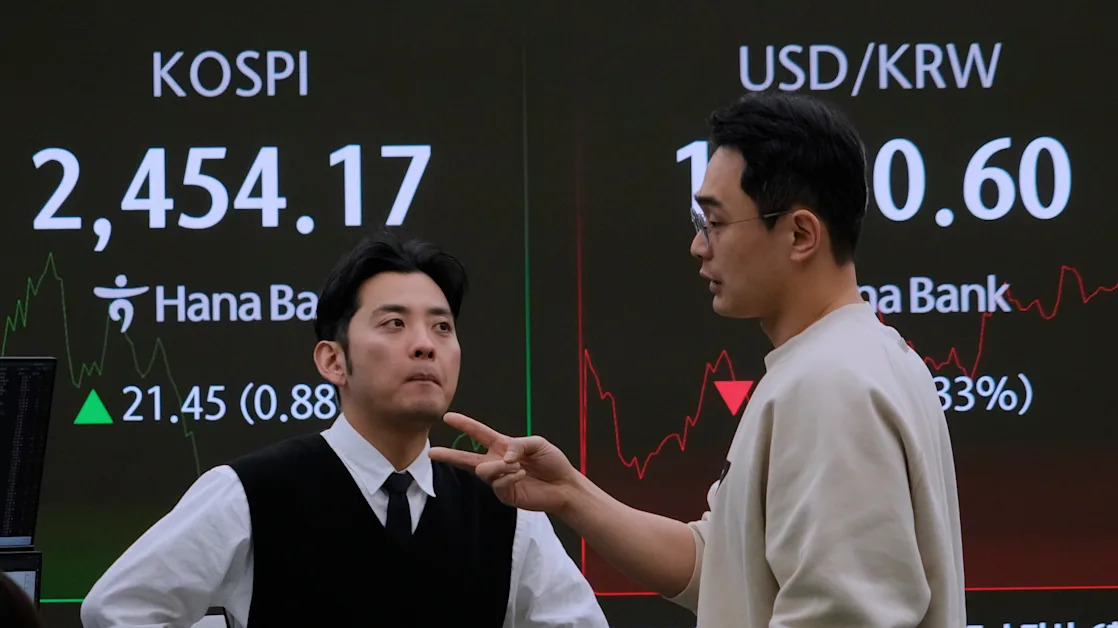
Asian markets rally after Wall Street ends higher in the chaotic and historic week
HONG KONG (AP) — Asian markets rallied on Monday as tensions over trade eased slightly after U.S. President Donald Trump said electronics such as phones and laptops would not be subject to the same high import duties as some other products.
U.S. futures also advanced after U.S. stocks jumped Friday. However, a weakening in the U.S. dollar and lower oil prices hinted at persisting worries over the direction of Trump’s trade war.
Japan’s Nikkei 225 rose 1.8% to 34,189.37 and South Korea’s Kospi gained 0.8% to 2,452.42.
Shares in technology companies surged, with Tokyo Electron up 2% and Advantest, a testing equipment maker, up 5.4%. South Korea’s biggest company, Samsung Electronics, gained 1.4%.
Hong Kong’s Hang Seng jumped 2.4% to 21,419.59, while the Shanghai Composite index picked up 0.9% to 3,266.26 after the government reported that
China’s exports
surged 12.4% in March from a year earlier.
U.S. President Donald Trump said he was exempting smartphones, computers and other electronics from his tariffs after
China announced
Friday that it was boosting its tariffs on U.S. products to 125% in the latest tit-for-tat increase following
Trump’s escalations on imports
from China.
The Chinese Ministry of Commerce said Trump’s move was “a small step” toward fixing its wrongful action of what Trump calls reciprocal tariffs. It urged him to completely cancel them.
Rising tensions between the world’s two largest economies could cause widespread damage and a possible global recession, even after Trump recently announced a
90-day pause
on some of his tariffs for other countries, except for China.
Australia’s S&P/ASX 200 added 1.5% to 7,758.70.
The Taiex rose 0.6% in Taiwan, whose economy is heavily dependent on exports of computer chips and other high-tech goods.
On Friday, the S&P 500 rose 1.8% to 5,363.36, capping a
chaotic and historic week.
The Dow Jones Industrial Average gained 1.6% to 40,212.7, while the Nasdaq composite jumped 2.1% to 16,724.46.
Stocks kicked higher as pressure eased a bit from
within the U.S. bond market
. It’s typically the more boring corner of Wall Street, but it’s been flashing serious enough signals of worry this week that it’s demanded investors’ and Trump’s attention.
The yield on the 10-year Treasury was trading at 4.466% early Monday. On Friday, it topped 4.58% in the morning, up from 4.01% a week ago. That’s a major move for a market that typically measures things in hundredths of a percentage point.
Bond yields typically fall in times of alarm. Investors outside the United States could be selling their U.S. bonds because of the trade war, and hedge funds could be selling whatever’s available to raise cash to cover other losses. More worryingly, doubts may be rising about the United States’ reputation as the world’s safest place to keep cash because of Trump’s frenetic, on-and-off tariff actions.
Gold
has been living up to its reputation as a safer haven for investors as its price hits new records. Early Monday it was trading at $3,249 an ounce, up $4.20.
All the uncertainty caused by the trade war is eroding confidence among U.S. shoppers, which could affect their spending and translate into damage for the economy, which
came into this year running at a solid rate
.
A
report on inflation
at the wholesale level came in better than expected, though that figure is backward looking, measuring March’s price levels. The worry is that inflation will rise in coming months as Trump’s tariffs make their way through the economy. And that could tie the Fed’s hands.
Friday’s swings came after a set of stronger-than-expected
profit reports
from some of the biggest U.S. banks, which traditionally help kick off each earnings reporting season.
JPMorgan Chase, Morgan Stanley and Wells Fargo all reported stronger profit for the first three months of the year than analysts expected. JPMorgan Chase rose 4%, Morgan Stanley added 1.4% and Wells Fargo lost 1%.
In other trading early Monday, U.S. benchmark crude oil lost 20 cents to $61.30 per barrel, and Brent crude, the international standard, fell 20 cents to $64.56 per barrel.
The U.S. dollar dropped to 143.05 Japanese yen from 143.91 yen. The euro climbed to $1.1379 from $1.1320.
