
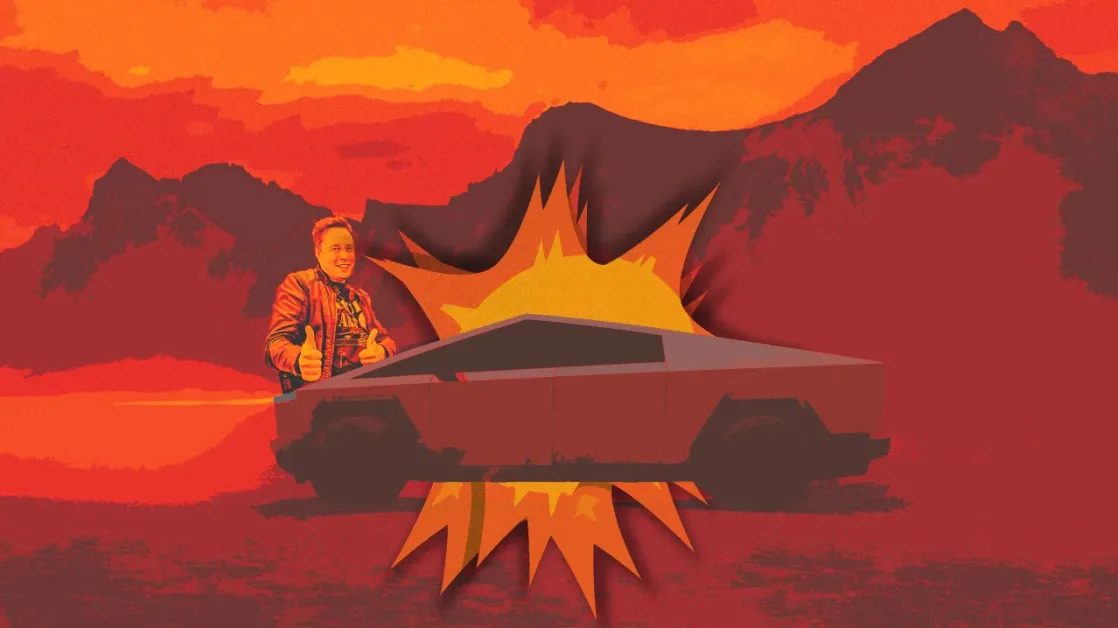
Elon Musk turns Cybertruck explosion into a marketing moment
The new year started out with
the worst kind of bang
. In the early hours of January 1, an assailant
exploded a Cybertruck
in front of Trump Hotel in Las Vegas, using firework mortars and gas canisters. Seven bystanders were injured in the blast, and the driver reportedly killed himself before the explosion.
Although the perpetrator has since
been identified
as off-duty soldier Matthew Livelsberger, many questions remain. The attacker’s motive is still unknown as of this writing, along with whether his actions have any connection to a
vehicular attack in New Orleans
the previous night, which left 15 dead and dozens injured. One thing that’s clear, though, is how the Cybertruck’s creator and champion Elon Musk would react to his signature vehicle being used in a potential terror attack. Turns out he would spin it into a marketing opportunity.
By evening the day of the explosion, Las Vegas law enforcement had
praised the Cybertruck’s sturdiness
for helping contain the explosion. The futuristic-looking vehicle has solid steel doors, which appear to have prevented the hotel’s glass doors from shattering. Musk quickly seized on this detail and began
tweeting
about it to his 210.2 million X followers, claiming the suspect “picked the wrong vehicle for a terrorist attack.” He went on to
retweet a fan
who described the incident as the tipping point in his decision to finally buy a Cybertruck.
On Thursday morning, Musk went a step further. He retweeted
a bloody illustration of the attack
, featuring an animated Musk saying of the explosion: “Best Tesla ad!” In the drawing, the exploded Cybertruck does not have a single scratch on it, even though the actual vehicle deployed in the attack had its
windows blown out and exterior singed
. (The tires did remain remarkably pristine, however.)
Musk took a roundabout path to arriving at the explosion as a marketing moment, though. He initially spent a lot of time on January 1 posting his ire at media outlets for their
clumsily worded headlines
about the incident, which he claimed
read as if the vehicle caught fire by accident
. Musk even suggested at one point that
he would sue
some of those publications. (Never mind that
Trump Hotel
itself also referred to the explosion as an
“electric vehicle fire”
on social media, as did executive VP of the Trump organization
Eric Trump
.)
But it wasn’t only media outlets that apparently jumped to concluding that the Cybertruck had somehow exploded on its own.
A lot
of
social media
users also
made that leap
.
Perhaps that shouldn’t be so surprising.
The angular vehicle, whose thick doors and frunk
have been criticized for having the potential to sever fingers
, has been recalled
a whopping seven times
in its first year—part of the reason Tesla was
the most recalled automaker of 2024
. Some of these recalls were for relatively minor infractions but others were for more serious issues, including a dangerous defect where
a trapped pedal
could lead to unintended acceleration.
More generally, drivers and observers have frequently posted
videos
of
Cybertrucks
getting
stuck
—especially on
the dedicated r/CyberStuck subreddit
. Some owners have complained that the vehicle
stalls with no explanation
, while others have said it can be extremely difficult to service. In March, for instance,
Rolling Stonedetailed
the plight of Cybertruck driver Matthew Chiarello, who described in a since-deleted tweet the “catastrophe failure” of his vehicle’s steering and brakes, which led to his truck being towed from a parking lot . . . on a day when Tesla’s service center was closed. (Chiarello followed up three days later to say that technicians had yet to diagnose the underlying problem.)
Not to mention that just one day before the Las Vegas attack,
a Cybertruck randomly caught fire
at a car dealership in Decatur, Georgia.
(A lot more cars catch fire in an average year
for a lot more reasons than one might think, but the Cybertruck’s design is so distinctive that it’s more likely to make the news when it goes up in flames.)
New info about the car, which has emerged since the blast, might similarly not instill confidence. Sheriff Kevin McMahill of the Las Vegas Police said
Musk helped the investigation
by unlocking the truck after it reportedly auto-locked in the blast and sent along video of the suspect at various charging stations. What this statement reveals is that the Cybertruck will auto-lock if the car catches fire, that the CEO of Tesla technically has remote dominion over
all its cars
, and that driving one means being easily surveilled. Not exactly the stuff commercials are made from.
Given all that the general public knows about Cybertrucks by now, and that according to estimates they reportedly
haven’t sold very well
, it’s easy to see why Musk would instead tout the vehicle as strong enough to thwart a terror attack. Even if a more tactful leader might have waited a while longer to do so.
Musk is now
going all in
on the idea that the injured bystanders are lucky the attacker chose a Cybertruck, but there’s just one problem with that narrative. For all anyone knows right now, the suspect chose a Cybertruck precisely because it’s a Cybertruck—not to inflict maximum damage, but to make a political point.
If the assailant had chosen a car
not
deeply associated with a man who just gave a quarter billion dollars to get a president elected, and if he hadn’t blown it up right in front of a hotel owned by that politician, the conversation about the car’s sturdiness might organically take precedence.
As it is, though, talking about a car that thwarts terror attacks seems to be a way to avoid talking about why an attacker might choose this particular car to send a message.
This post originally appeared at
fastcompany.com
Subscribe to get the Fast Company newsletter:
http://fastcompany.com/newsletters
