
Is $8 Trillion Stimulus Enough? Fed’s Inflation Target Under Siege!
The Great Deception: Fed’s One-Time Stimulus Becomes Permanent Expansion
One of the most fascinating aspects of Fed watching is recognizing how short-lived a memory span everyone in the financial media has. During the Great Financial Crisis, Fed Chairman Ben Bernanke stated that the economy needed a ONE-TIME stimulus of $600 billion to save the banking system. However, immediately after this statement, the Fed embarked on creating Quantitative Easing 1, Quantitative Easing 2, Quantitative Easing 3, and even Quantitative Easing Infinity, as well as providing untold amounts ofstimulus to prevent the system from collapsing.
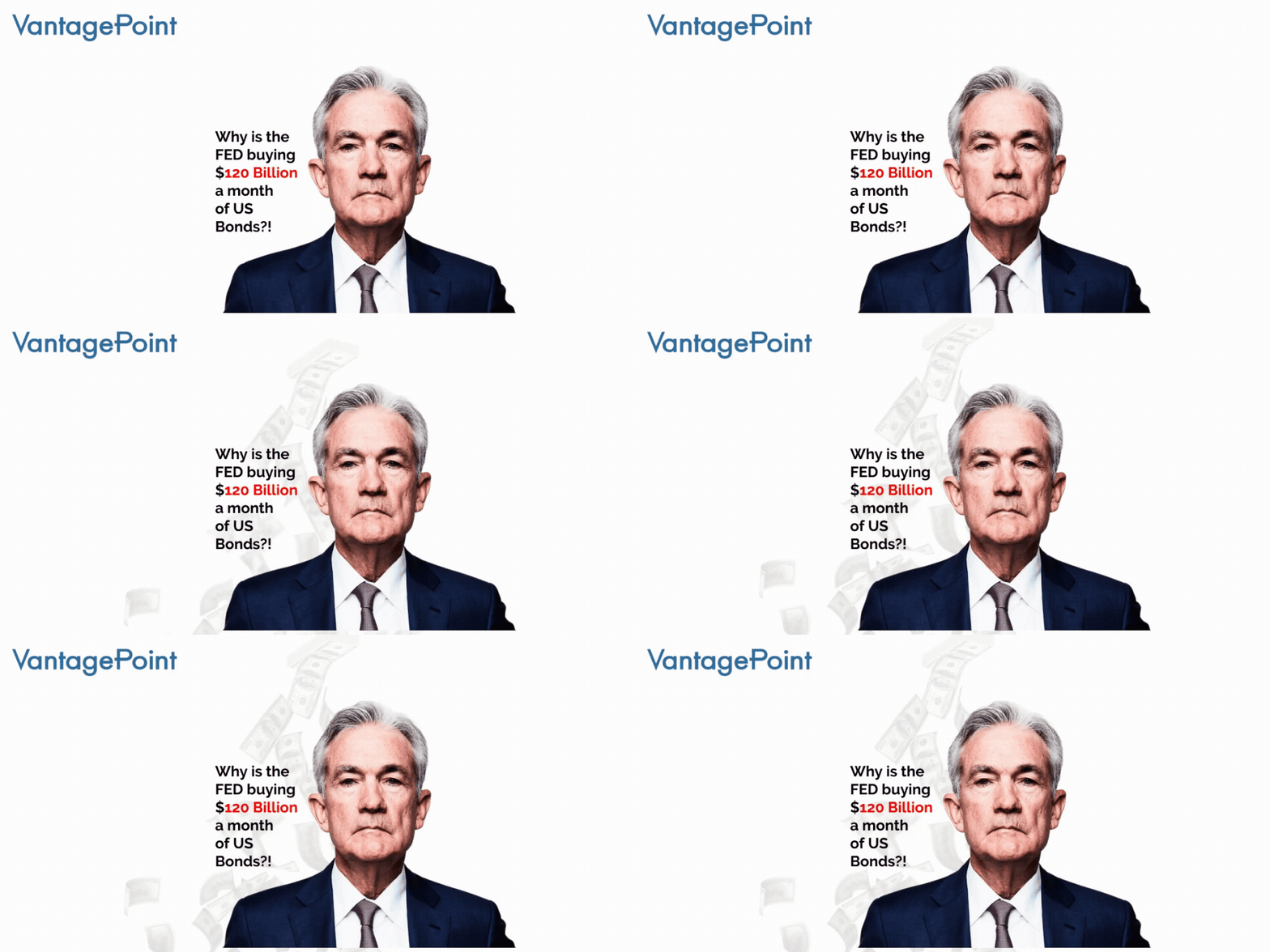
Today, the Fed’s balance sheet boasts over $8 trillion in assets. In contrast, during the Great Financial Crisis, it only had $800 billion on its books. So much for a ONE-TIME stimulus! The Fed is currently buying $120 billion dollars a month of US Bonds for reasons that will be discussed later in this article.
Given these developments, one would think that someone would ask why the economy needs all this new liquidity constantly when previous to 2008 it did not. What changed?
The COVID-19 Crisis: Trillions in Helicopter Money Stimulus
===========================================================
Over the past year, as the economy was locked down due to COVID-19, the Treasury and the Fed created trillions in Helicopter Money Stimulus to support the economy. Critics warned of inflationary headwinds and referred to this stimulus as currency debasement. The Fed, through Jerome Powell, assured everyone that they were vigilant, in control, and would hit their 2% inflation target.
However, nobody knows over what timeframe this 2% inflation target is measured. Recent announcements by the Bureau of Labor Statistics have many individuals worried that a 1970’s style inflation is back in full swing.
Recent Economic Numbers: A Recipe for Concern
=====================================================
Let’s examine some recent economic numbers that indicate why there are serious concerns about inflation:
- Monthly Inflation Rate Last 12 Months
On July 13, 2021, the CPI numbers came in at 5.4% for June, which was 10% higher than the mainstream economists had forecasted. A miss by 10% is an impressive feat given that they spend all day creating econometric models to understand what’s happening in the economy.
- Core Inflation Rate
When you remove the food and energy from the mix, core inflation rose to 4.5% for the month of June. This makes the June CPI the highest it has been in 13 years and core inflation as high as it has been since 1991.
The chart below shows the core inflation rate over time:
Core Inflation Rate
- Producer Price Index Numbers
To make matters worse, yesterday the Producer Price Index numbers were released, and they showed an even greater inflationary concern. Wholesale prices rose 7.3% in June on a year-over-year basis. This is another indicator of inflation moving faster than the markets had anticipated.
The chart below illustrates this:
Producer Price Index 2011 to 2021
This chart was created by the Fed and goes back ten years. Any seasoned trader examining this chart of Producer Prices would have to conclude that a break out has occurred, with us seemingly rocketing through the 2% inflation rate that the Fed assured us was their target.
Real Rate of Return: Red Flags
================================
There are several reasons why this level of concern is justified, but one of the main factors is THE REAL RATE of RETURN. This metric is calculated by looking at the yield of the Ten-Year Bond and subtracting the Core Inflation rate.
The 10 Year Bond is yielding 1.321%
Core Inflation was 4.5%
This makes the Real Return on 10 Year U.S. Treasuries -3.179%. Who do you know that will invest in the Ten-Year Bond to guarantee a greater than 3% loss? The absolute real rate of return after taxes is even worse.
The Insanity of the Current Financial Environment
=====================================================
This metric describes why the Fed is buying $120 billion of Treasury Bonds every month and putting them on their balance sheet. What rationale is there for any investor or trader of average intelligence to think that this will somehow grow the purchasing power of our portfolio?
In today’s financial environment, finding value has become a completely consuming activity for traders and investors. The target moves quickly based upon too many factors that remain unseen to the naked eye.
Artificial Intelligence: A Solution?
=====================================
Most traders struggle with the timing of their trades. If you want to win, it’s all about being on the right side of the right trend at the right time. AI excels at keeping traders on this side of the market.
The market is brutally honest – there are winners and losers. It’s very black and white. If you need a friend, get a dog. But if you’re going to win in this jungle called the trading world, someone else must lose. Survival of the fittest makes many uneasy; stay out of the financial markets if it does.
The Dilution of Money
==========================
We live in unique times, and everyone is aware that if the money supply grows 20%, you’ve got to grow your portfolio by a similar amount just to break even when looking at your purchasing power. Artificial intelligence has beaten humans in Poker, Chess, Jeopardy, and Go! Do you really think trading is any different?
The printing press is diluting the value of your money. Since AI can outperform human traders in various games, do not expect it to be different in finance.
Protecting Purchasing Power
=============================
As an investor or trader, you’re tasked with protecting and growing your purchasing power. This is no easy task given today’s environment.
There are several solutions, but they all start with the idea that AI can deliver knowledge – useful knowledge. However, its application in the trading world has shown to result in more rewards and less risks for professional traders.
