
Luxury Stocks Find China Solace to End Bad Year on Brighter Note
(Bloomberg) — A December rebound in European luxury-goods stocks is easing the pain for investors after a year characterized by concerns over weakening demand in the key market of China.
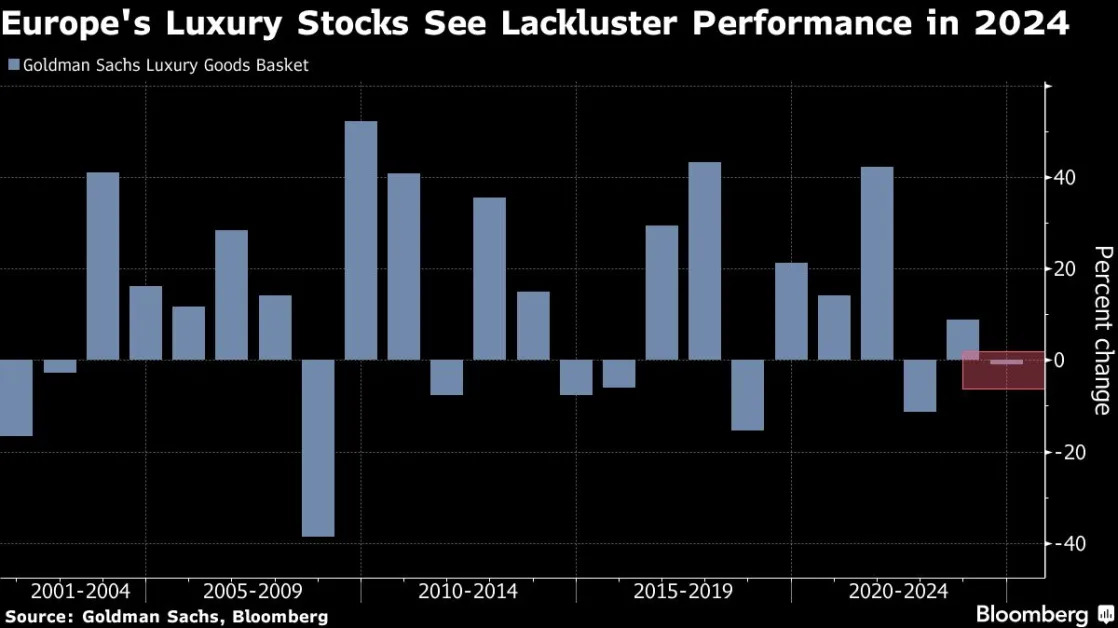
Optimism is returning following numerous rounds of Chinese stimulus to rejuvenate the world’s second-biggest economy, which have put shares in makers of high-end goods on course for their best month since February. A Goldman Sachs Group Inc. basket tracking the sector is up over 8% in December, trimming its year-to-date drop to only 1%.
These green shoots highlight investor sensitivity to China — whose consumers account for nearly 15% of the global luxury market. The Asian nation recently signaled further stimulus measures, providing the catalyst for a rally similar to one in September, which quickly became exhausted.
Another expected boon for luxury demand next year could come from the US, where Donald Trump’s plans to deregulate the economy and reduce taxes may provide a boost to spending.
“For many luxury companies, China and the US remain key catalysts for the short-term,” said Dora Buckulčíková, a portfolio manager at Robeco Switzerland Ltd. “We are positive on both” even as the exact timing of the turnaround is “still uncertain,” she said in an interview.
This year has been notable for declines in LVMH Moet Hennessy Louis Vuitton SE, the world’s biggest luxury stock, which was Europe’s largest listed company as recently as mid-2023, before being overtaken by drug maker Novo Nordisk A/S.
LVMH shares have slumped 14% in 2024 to date, their worst annual performance since the global financial crisis in 2008. The stock now trades at 22 times its 12-month blended forward price-to-earnings, below an average of about 25 times since 2018.
For 2025, investors are pinning their hopes on a pick-up in the US, where the president-elect has helped boost both the stock market and the dollar. In the latest sign of resilient demand at the upper-end of the luxury spectrum, Brunello Cucinelli SpA raised its revenue growth guidance last week, with analysts pointing to a benefit from the firm’s exposure to the US market.
“More recent company results have shown an improvement for some well positioned companies in the US and European market,” said Giles Rothbarth, co-head of European equities at BlackRock Fundamental Equities. “A continuation of this trend, supported by improved consumer confidence, higher wages, and particularly in the US the post-election ‘animal spirits’ could aid luxury companies from here.”
The sector still faces challenges, however. A trade war as Trump returns to the White House could dent sentiment, while in China, growing numbers of consumers are turning their backs on bling as economic malaise cuts short a post-pandemic splurge. Rising prices for high-end goods have also put a dent in demand.
“Signs of ‘luxury fatigue’ with consumers increasingly questioning the value for money offered by some brands suggest to us that a potential recovery may come only in 2026,” said Zuzanna Pusz, an analyst at UBS Group AG in London.
Diverging share prices also speak to caution. Investors have, in particular, avoided companies in the process of orchestrating a turnaround. The stocks of Gucci-owner Kering SA, Salvatore Ferragamo SpA, Burberry Group Plc and Hugo Boss AG are all down more than 30%. In contrast, some of those catering to the wealthiest clients, like Hermes International SCA and Cucinelli, have seen valuations surge nearly 20%.
READ: Hugo Boss’s Revamp Snag Brings Worst Year Since Financial Crisis
For some, it’s important to be selective given the way forward for luxury stocks is unlikely to be straightforward.
“I definitely wouldn’t be buying luxury as a whole,” said Marcel Stotzel, a portfolio manager at Fidelity International. Stotzel sees 2025 as a “transitional year” for the industry, with any bets of a “big recovery” hinging on a revival in US demand, he said in an interview.
–With assistance from Michael Msika.
