
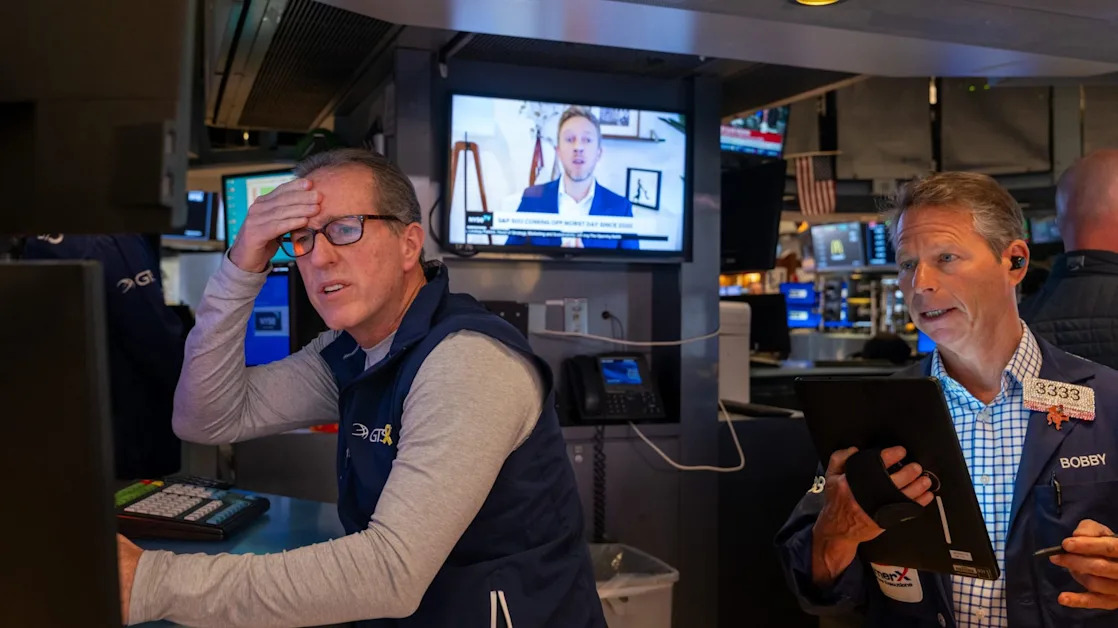
Markets might be celebrating but every single portfolio manager is trying to figure out how long the roller coaster will last
Stock markets erupted with a torrential surge of optimism following President Donald Trump’s post on Truth Social
pausing
some of his tariffs, and comments from Treasury Secretary Scott Bessent reassuring the world that the U.S. is not embroiled in a trade war.
Despite the brief respite from the carnage of the week, though, a
chilling uncertainty
looms over the next 90 days.
“Every portfolio manager is trying to figure out whether you can draw a straight line to future negotiations,’” said Jake Schurmeier, portfolio manager at Harbor Capital and a former member of the Federal Reserve Bank of New York’s Markets Group. “We get another 90 days before we have to do this song and dance again.”
To level set: President Trump announced
a bevy of tariffs
during a Rose Garden address last week that had been telegraphed since his campaign. Investors had priced in tariffs and the subsequent impact on trade policy, but the extent of the tariffs was
greater than expected
. Markets plummeted in the trading days after Trump’s announcement. The word “recession”—typically
avoided
at all costs—became a talking point, and the chances of the U.S. stumbling headlong into one
rose
, according to
JPMorgan Chase
, whose CEO Jamie Dimon
announced publicly
that a recession was a “likely outcome” after the tariff tumult. Trump said Dimon’s comments factored into
his decision
to issue the partial pause on Wednesday.
Following Trump’s announcement, markets staged a gravity-defying rally, with the Nasdaq ending the day up 12%, while the S&P 500 rose more than 9%.
Michael Orlando, executive director in the J.P. Morgan Center for Commodities and Energy Management at the University of Colorado Denver, told
Fortune
the tariff pause is a relief, mostly from uncertainty, which had continued to weigh on equity prices. But the
bigger development
, which emerged over the weekend, was that U.S. Treasuries “stopped looking like a safe harbor in a time of uncertainty and started looking like a risky bet, themselves,” Orlando said.
“I think this tariff ‘cooling off’ period did a lot to dispel concerns that maybe the President doesn’t understand the idea of gains from trade,” Orlando added.
But the question remains: What happens next?
‘Ample Air Cover’
First, there’s the consideration as to whether the damage from tariffs will be lasting, along with the cost of pervasive economic uncertainty, said Schurmeier. All the planning around capital expenditures and major strategic moves just got tossed out the window because there is no certainty, he said.
The portfolio manager noted there will be critical signs to look out for during earnings calls between major companies and analysts this week, particularly regarding how CEOs and CFOs plan to grapple with questions about tariffs—and anything else that might cause disruptions.
“This provides ample air cover to drop any bad news,” said Schurmeier. “Any bad news you have, get it out this quarter.”
Money managers will also be watching to see how big bank leaders, such as Dimon, talk about how their clients are responding, perspective on M&A activity, and guidance about their willingness to provide credit, Schurmeier added. Right now, it’s too early to talk about potential loan losses, but other topics will be indicative about whether there’s stronger business sentiment.
“Whatever they say will be pretty instructive,” said Schurmeier.
China: From 104% to 125%
The other major looming issue is
China
.
The next few weeks are likely to zero in on the impact of possible further retaliation after China pledged to “fight to end” even before Trump raised tariffs on the country to 125%. Trump countered with no pause on China tariffs, and instead
hiked them
because of China’s “lack of respect,” the president wrote on social media.
Idanna Appio, a portfolio manager at First Eagle Investments and former deputy head of the global economic analysis department at the Federal Reserve Bank of New York, said the situation with China is extremely serious, from tariff levels to the potential for a broken trading relationship between the world’s two largest economies.
It’s unclear if Trump’s latest move will push China toward negotiation on tariffs or if economic tensions will reach such a level that China becomes more confrontational in the geopolitical sphere, Appio said.
“Given the sharp escalation and the economic friction between the U.S. and China, which is obviously not good for the global economy, does that spillover to the geopolitical side?” she said. “If they feel they have nothing left to lose…does China start to push into other domains? I hope the answer to that is, ‘No.’”
Economic Outlook: ‘Very Tenuous’
Beyond
what might happen with China, the U.S. economy remains in a “very tenuous place,” Appio said.
She put a recession into her forecast but Appio said she isn’t sure if she’s removing it at this stage because of looming uncertainty even if tariffs aren’t as large as those initially announced last week. Plus, there’s still room for further tariff action and few uncertainties have been truly eliminated at this stage.
“One fear I have is that we wind up repeating this whole exercise in 90 days,” said Appio. “It’s been a roller coaster ride, to say the least.”
