
The state of the American consumer in a single quote
A version of this post was originally published on Tker.co.
Every once in a while, we’ll get a
single anecdote
that
succinctly reflects
a much bigger story in the economy.
Last week, we got such a perspective from Walmart CFO John David Rainey after the release of the company’s second quarter financial results. Via
WSJ
(emphasis added):
We continue to believe that customers are discerning, they are choiceful, they are focusing on essentials versus discretionary items, but
we have not seen any incremental fraying of consumer health. … I wouldn’t say strength, but lack of weakness
.
In other words, the American consumer isn’t spending as recklessly as they used to. But they aren’t falling apart.
This is in line with an economy that has become
less coiled
, highlighted by a
cooling labor market
that has
become more balanced
. And despite household
excess savings falling
and
debt delinquencies rising
as they normalize to prepandemic levels,
consumer finances generally remain very healthy
.
The consumers’ ability and
willingness to spend
is a big deal as personal consumption accounts for
68% of GDP
. If consumers are spending, odds are the economy is growing.
Walmart, America’s largest retailer,
reported Q2 net sales
that grew a healthy 4.8% year-over-year, fueled by 4.2% growth in U.S. same-store sales. Management even boosted its full year guidance, projecting 3.75% to 4.75% growth in fiscal 2025 (up from a range of 3.0% to 4.0%).
And this is not just a Walmart story.
According to national data released by the
Census Bureau
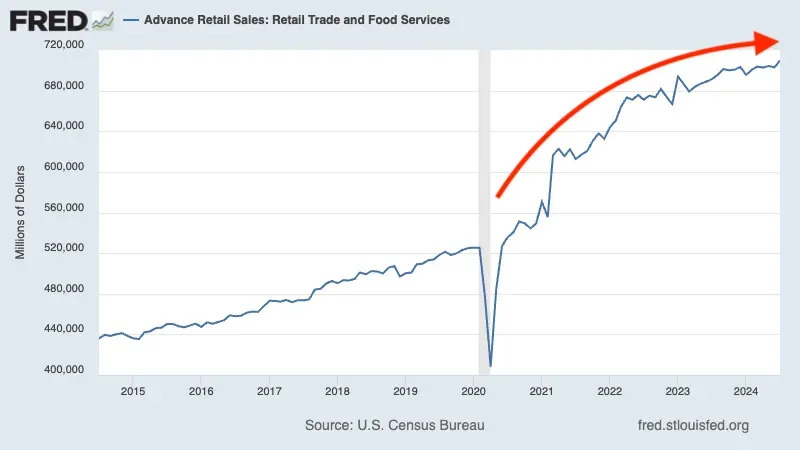
on Thursday, retail sales in July grew 2.7% year-over-year to a record $709.7 billion.

While retail sales were up an impressive 1% from the prior month, I’d be reluctant to say they’re reaccelerating. Data has a tendency to
zig zag month to month
. When you
zoom out a bit
, it’s clear that spending growth has been plateauing, which is in line with
other cooling economic metrics
.
A cooling economy isn’t a bad thing
Economic growth isn’t as scorching hot as it used to be. But that isn’t necessarily a bad thing — we seem to be experiencing a
“goldilocks” set of conditions
where economic activity is still growing while inflation remains cool.
These conditions aren’t necessarily bad for the stock market either.
Sure, cooling demand in the economy is a headwind for sales. But
as we’ve been discussing
, companies have shown they can convert modest sales growth into more robust earnings growth thanks to
operating leverage
. This is critical, because as we always say, earnings are the
most important long-term driver
of stock prices. It’s the “
bottom line
.”
Read more
here
and
here
.

It’s a good reminder of how
the stock market is not the economy
. Because, it’s
possible for the stock market to outperform the economy
.
Related from TKer:
Reviewing the macro crosscurrents
There were a few notable data points and macroeconomic developments from last week to consider:
️
Shopping rises to new record level
.
Retail sales
inched higher in July to a record $709.7 billion.

Strength was broad with growth in cars and parts, electronics, health and personal care, grocery, restaurants and bars, building materials, and furniture.

For more on the consumer, read:
There’s more to the story than ‘excess savings are gone’
and
The US economy is now less ‘coiled’
Card spending data is cooling
. From Bank of America: “Total card spending per HH was down 1.0% y/y in the week ending Aug 10, according to BAC aggregated credit & debit card data. While still negative, department store, home improvement & furniture spending growth saw the largest increase since last week. Meanwhile, transit and gas were the only two sectors we report on below that saw a decline in spending growth since last week.

For more on consumer finances, read:
Unsettling stats about consumer health are missing the bigger picture
Unemployment claims ticked lower
.
Initial claims for unemployment benefits
declined to 227,000 during the week ending August 10, down from 234,000 the week prior. While this metric continues to trend at levels historically associated with economic growth, recent prints have been trending higher.

For more on the labor market, read:
The labor market is cooling
Inflation cools
. The
Consumer Price Index
(CPI) in July was up 2.9% from a year ago, down from the 3.0% rate in June. This was the lowest print since March 2021. Adjusted for food and energy prices, core CPI was up 3.2%, down from the 3.3% rate in the prior month. This was the lowest increase in core CPI since April 2021.

On a month-over-month basis, CPI rose just 0.2%. Core CPI also increased by 0.2%.
If you annualized the rolling three-month and six-month figures — a better reflection of the short-term trend in prices — the core CPI was up 1.6% and 2.8%, respectively.

Broad measures of inflation are way down from peak levels in the summer of 2022 and are now trending near the Fed’s target rate of 2%.
For more, read:
Inflation: Is the worst behind us?
Inflation expectations remain cool
. From the New York Fed’s
July Survey of Consumer Expectations
: “Median one- and five-year-ahead inflation expectations were unchanged in July at 3.0% and 2.8%, respectively. Conversely, median three-year-ahead inflation expectations declined sharply by 0.6 percentage point to 2.3%, hitting a series low since the survey’s inception in June 2013.”

For more, read:
The end of the inflation crisis
⛽️
Gas prices tick lower
. From
AAA
: “The national average for a gallon of gas hit $3.44, falling by just a penny since last week. …According to new data from the Energy Information Administration (EIA), gas demand edged higher last week from 8.96 million b/d to 9.04. Meanwhile, total domestic gasoline stocks fell from 225.1 to 222.2 million barrels. Gasoline production decreased slightly last week, averaging 9.7 million barrels per day. Tepid gasoline demand and stable oil costs may cause pump prices to slide further.”

For more on energy prices, read:
Higher oil prices meant something different in the past
️
Homebuilder sentiment falls.
From the
NAHB’s Carl Harris
: “Challenging housing affordability conditions remain the top concern for prospective home buyers in the current reading of the HMI, as both present sales and traffic readings showed weakness. The only sustainable way to effectively tame high housing costs is to implement policies that allow builders to construct more attainable, affordable housing.”

New home construction falls
. Housing starts fell 6.8%% in July to an annualized rate of 1.2 million units, according to
the Census Bureau
. Building permits declined 4% to an annualized rate of 1.4 million units.

For more on housing, read:
The U.S. housing market has gone cold
Mortgage rates trend lower
. According to
Freddie Mac
, the average 30-year fixed-rate mortgage is at 6.49%. From Freddie Mac: “While rates increased slightly this week, they remain more than half a percent lower than the same time last year. In 2023, the 30-year fixed-rate mortgage nearly hit 8%, slamming the brakes on the housing market. Now, the 30-year fixed-rate hovers around 6.5% and will likely trend down in the coming months as inflation continues to slow. Lower rates are good news for potential buyers and sellers alike.”

There are
146 million housing units
in the U.S., of which 86 million are
owner-occupied
and
39%
of which are
mortgage-free
. Of those carrying mortgage debt, almost all have
fixed-rate mortgages
, and most of those mortgages
have rates that were locked in
before rates surged from 2021 lows. All of this is to say: Most homeowners are not particularly sensitive to movements in home prices or mortgage rates.
For more on mortgages and home prices, read:
Why home prices and rents are creating all sorts of confusion about inflation
Weekly mortgage applications rise
. From
Mortgage Bankers Association’s Joel Kan
: “Overall applications increased almost 17% to the highest level since January 2023, driven by a 35% increase in refinance applications. The refinance index also saw its strongest week since May 2022 and was 117% higher than a year ago, driven by gains in conventional, FHA, and VA applications. Additionally, purchase applications increased by 3%, with small gains seen across the various loan types, indicating that prospective homebuyers are slowly reentering the market.“

Consumer sentiment ticks higher
. From the University of Michigan’s
August Surveys of Consumers
: “Overall, expectations strengthened for both personal finances and the five-year economic outlook, which reached its highest reading in four months, consistent with the fact that election developments can influence future expectations but are unlikely to alter current assessments. Survey responses generally incorporate who, at the moment, consumers expect the next president will be. Some consumers note that if their election expectations do not come to pass, their expected trajectory of the economy would be entirely different. Hence, consumer expectations are subject to change as the presidential campaign comes into greater focus, even as consumers expect that inflation-still their top concern-will continue stabilizing.”

More from the survey: “With election developments dominating headlines this month, sentiment for Democrats climbed 6% in the wake of Harris replacing Biden as the Democratic nominee for president. For Republicans, sentiment moved in the opposite direction, falling 5% this month. Sentiment of Independents, who remain in the middle, rose 3%. The survey shows that 41% of consumers believe that Harris is the better candidate for the economy, while 38% chose Trump.“

Weak consumer sentiment readings appear to contradict resilient consumer spending data.
For more on this contradiction, read:
What consumers do > what consumers say
,
We’re taking that vacation whether we like it or not
, and
Sentiment: Finally a vibe-spansion?
Small business optimism improves
. The
NFIB’s Small Business Optimism Index
in July rose to the highest level since February 2022.

Importantly, the more tangible “hard” components of the index continue to hold up much better than the more sentiment-oriented “soft” components.

Keep in mind that during times of perceived stress, soft data tends to be more exaggerated than actual hard data.
For more on this, read:
What businesses do > what businesses say
and
Sentiment: Finally a vibe-spansion?
The entrepreneurial spirit is alive
. Small business applications, while down slightly from the previous month, remain well above prepandemic levels. From the
Census Bureau
: “July 2024 Business Applications were 420,802, down 2.1% (seasonally adjusted) from June. Of those, 135,465 were High-Propensity Business Applications.“

For more on what the business formation boom means, read:
Promising signs for productivity
⚙️
This is the stuff pros are worried about
. According to BofA’s July Global Fund Manager Survey, “U.S. recession (39% up from 18% in July) has replaced geopolitical conflict (25%) as the #1 tail risk.”

The truth is we’re always worried about something. That’s just the nature of investing.
For more on risks, read:
Sorry, but uncertainty will always be high
,
Two times when uncertainty seemed low and confidence was high
, and
What keeps me up at night
️
Industrial activity ticks lower.
Industrial production activity
in July fell 0.6% from the prior month. Manufacturing output fell 0.3%. From the Federal Reserve: “Early July shutdowns concentrated in the petrochemical and related industries due to Hurricane Beryl held down the growth of industrial production by an estimated 0.3 percentage point.“

For more on activity stabilizing as inflation cools, read:
The bullish ‘goldilocks’ soft landing scenario that everyone wants
Near-term GDP growth estimates remain positive
. The
Atlanta Fed’s GDPNow model
sees real GDP growth climbing at a 2.0% rate in Q3.

Putting it all together
We continue to get evidence that we are experiencing a
bullish “Goldilocks” soft landing scenario
where inflation cools to manageable levels
without the economy having to sink into recession
.
This comes as the Federal Reserve continues to employ very tight monetary policy in its
ongoing effort to get inflation under control
. While it’s true that the Fed has taken a less hawkish tone in
2023
and
2024
than in
2022
, and that most economists agree that the final interest rate hike of the cycle has happened, inflation still has to
stay cool for a little while
before the central bank is comfortable with price stability.
So we should
expect the central bank to keep monetary policy tight
, which means we should be prepared for relatively tight financial conditions (e.g., higher interest rates, tighter lending standards, and lower stock valuations) to linger. All this means
monetary policy will be unfriendly to markets
for the time being, and the risk the
economy slips
into a recession will be relatively elevated.
At the same time, we also know that stocks are discounting mechanisms — meaning that
prices will have bottomed before the Fed signals a major dovish turn in monetary policy
.
Also, it’s important to remember that while recession risks may be elevated,
consumers are coming from a very strong financial position
. Unemployed people are
getting jobs
, and those with jobs are getting raises.
Similarly,
business finances are healthy
as many corporations
locked in low interest rates on their debt in recent years
. Even as the threat of higher debt servicing costs looms,
elevated profit margins
give corporations room to absorb higher costs.
At this point, any
downturn is unlikely to turn into economic calamity
given that the
financial health of consumers and businesses remains very strong
.
And as always,
long-term investors
should remember that
recessions
and
bear markets
are just
part of the deal
when you enter the stock market with the aim of generating long-term returns. While
markets have recently had some bumpy years
, the long-run outlook for stocks
remains positive
.
For more on how the macro story is evolving, check out the
the previous TKer macro crosscurrents »
