
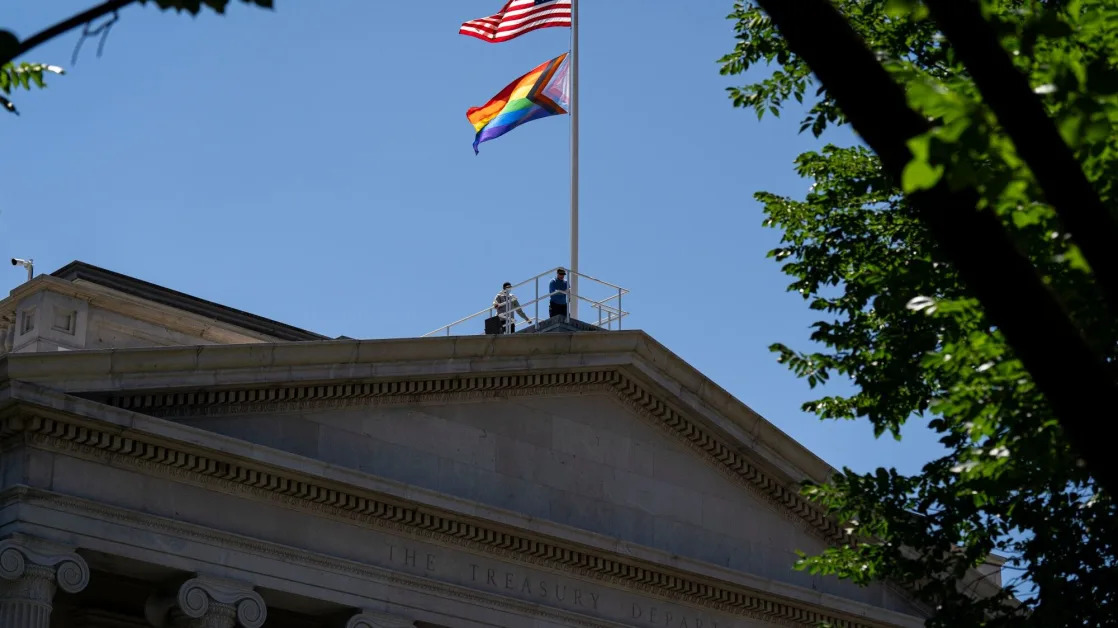
Wall Street Watchdogs Quietly Scrub DEI Pages After Trump Orders
(Bloomberg Law) — Federal banking and securities regulators, including several intended to operate independently from the White House, are starting to delete references to internal diversity and inclusion offices from their websites following executive orders from President Donald Trump.
Several agencies—including the Federal Reserve, Federal Deposit Insurance Corp., Office of the Comptroller of the Currency, and Commodity Futures Trading Commission—had removed webpages for their DEI programs and for their offices of minority and women inclusion as of late Thursday.
That doesn’t mean all the offices handling those issues are completely closed at this point, according to sources with knowledge of the matter.
The Securities and Exchange Commission also removed its DEI page, though its OMWI page remained active late Thursday.
Trump on his first days in office signed executive orders calling on federal agencies to rescind diversity, equity, inclusion, and accessibility initiatives. Such programs “undermine our national unity, as they deny, discredit, and undermine the traditional American values of hard work, excellence, and individual achievement in favor of an unlawful, corrosive, and pernicious identity-based spoils system,” Trump’s Jan. 21 order said.
The Office of Personnel Management followed with a directive for agencies to put all DEI staff on leave ahead of possible termination and to take down all DEI webpages by 5 p.m. on Jan. 22. It also ordered agencies to stop any DEI trainings and instructed employees to report if their agencies were making only cosmetic changes.
The initial actions are part of a sweeping effort by the Trump administration to eliminate diversity initiatives within the federal government. Trump also called on agencies to push for similar DEI rollbacks in the private sector.
“I’m slightly concerned by it, because I don’t know if this could eventually have unintended consequences and result in a return to the old boys’ club,” said Janaya Moscony, president at SEC3 Compliance, who worked at the SEC from 1995 to 2000. “When I was at the SEC, they were cognizant to hire a different variety of people, minorities, everyone.”
Legal Mandate
The removal of the webpages was notable in part because Congress established the prudential banking regulators as independent agencies that act with some political autonomy.
Lawmakers also explicitly required financial regulatory agencies to establish the minority and women inclusion offices under Section 342 of the Dodd-Frank Act, with the goal of attracting talent, fostering inclusion, and developing standards to assess diversity policies and practices among regulated entities.
It’s unclear whether all the covered agencies had disbanded those offices altogether, but their initial compliance with Trump’s directives sent a chilling signal, said Jesse Van Tol, the president and CEO of the National Community Reinvestment Coalition.
Trump’s executive action “doesn’t have the same force as law, and the creation of those offices was established under the law in Dodd-Frank,” Van Tol said. “If they did indeed shut down access to the websites in response to the executive order, that would be troubling and potentially legally problematic.”
The Consumer Financial Protection Bureau, which is still led by Biden appointee Rohit Chopra, continued to maintain its OMWI page and related content as of late Thursday.
The Fed, FDIC, and OCC declined to comment. The CFPB, SEC, and CFTC didn’t respond to requests for comment.
Like the Fed board, most of the 12 regional Federal Reserve banks had also deleted their diversity and inclusion websites. The regional banks aren’t officially government agencies.
Representatives for the regional Fed banks declined to comment or didn’t immediately respond.
FDIC Scandal
The FDIC and the Fed still have offices handling diversity and inclusion efforts as mandated by Dodd-Frank and other federal laws, according to sources familiar with the matter.
The FDIC put some employees on leave as per the OPM directive, the sources said. But it’s unclear how many were affected.
The FDIC’s moves come as it attempts to recover from a workplace harassment scandal under former Chairman Martin Gruenberg, who was implicated in a series of reports starting in 2023 for having a short temper and verbally abusing staff. The agency had put forward an action plan to improve working conditions that Travis Hill, the FDIC’s current acting chairman and then-vice chairman, said didn’t go far enough.
In a Jan. 21 statement of priorities, Hill said the FDIC would take action to “reestablish a strong workforce culture, where misconduct is not tolerated and those who engage in misconduct are held accountable.”
But eliminating diversity and inclusion activities at the FDIC could make the agency less welcoming to women and minorities, Van Tol said.
“If you’re signaling that inclusion is not important as an agency, then I think you’re telling the people who work for you who may have been historically excluded that they can’t expect you to prioritize inclusion in any sense,” he said.
Selective Compliance
The Fed’s quick acquiescence to Trump’s DEI executive orders stands in stark contrast to its slow response to former President Joe Biden’s 2021 executive order calling on regulators to update their bank merger review guidelines.
The Fed has yet to undertake and complete such a review.
“It is interesting to see which executive orders the Federal Reserve chooses to comply with, and which it decides to ignore,” said Jeremy Kress, a professor at the University of Michigan’s Ross School of Business and a former Fed attorney. Kress advised the Justice Department on its own update to bank merger review guidelines.
While Trump said his executive orders were meant to put a focus on merit in hiring and promotions at federal agencies, they have the potential to push out qualified personnel, Moscony said.
“If we are regressing to outdated decision-making like, ‘I’m going to hire you because I know your dad,’ then I’m not on board with the direction we are taking here,” she said.
To contact the reporters on this story: Evan Weinberger in New York at [email protected]; Ben Miller in New York at [email protected]
To contact the editors responsible for this story: Michael Smallberg at [email protected]; Maria Chutchian at [email protected]
