
Where Will Ford Stock Be in 10 Years?
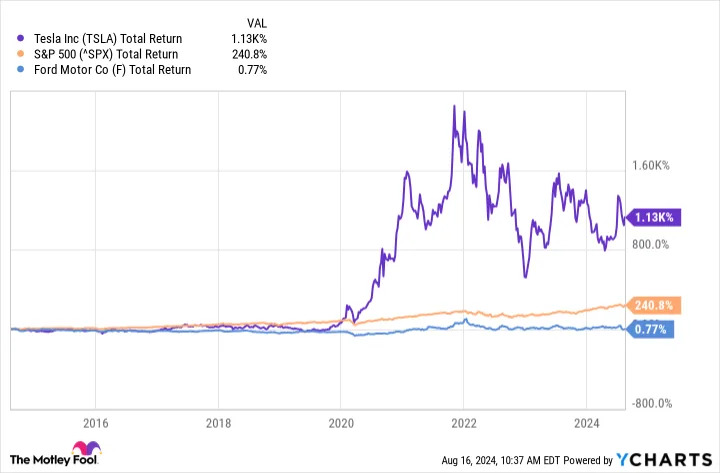
Returning almost nothing over the previous 10 years (even when including dividend payments),
Ford Motor Company
(NYSE: F)
has been a pretty pathetic long-term investment. For context, the
S&P 500
returned 241% over the same period, while upstart automaker
Tesla
grew by 1,100%.
While past performance doesn’t predict the future, it can give some hints. Let’s explore what the next decade could
have in
store for Ford as it seeks to consolidate and improve its business.
The EV boom became the EV
bust
Like many legacy automakers, Ford
was swept up
in the much-hyped transition to
electric vehicles
(EVs), which promised to turn its lumbering internal-combustion-engine-powered business into something more exciting and innovative.
But
while the company is quickly adopting the new technology, it hasn’t been much of a boon for the bottom line.

In the second quarter, Ford’s new EV segment, Model E, lost $1.1 billion — a staggering $46,000 per vehicle sold. That brings total segment losses to $2.5 billion this year, due in part to an industry price war as companies grapple with rising competition and soft demand.
There are several catalysts for the market weakness. For starters, high interest rates make cars less affordable because these big-ticket purchases
are typically made
with the help of credit. The expected Federal Reserve rate cuts could help the situation.
But
analysts at J.P. Morgan believe the U.S. economy has a 35% chance of entering recession by year’s end, which would also hurt car buying demand.
What do the next 10 years have in store?
Over the long term, EV demand seems likely to bounce back and slowly replace demand for traditional ICE vehicles as battery technology improves and enabling infrastructure like charging stations are built out. However, it is still unclear what this trend will mean for Ford and other industry participants.
The past few years indicate that EV manufacturing is becoming less profitable. The new technology is also shifting the automotive industry’s center of gravity to China, where manufacturers like
BYD
can produce EVs at shockingly low prices because of their vertical integration. BYD’s cheapest car, the Seagull, sells for
the equivalent of
$9,700 in China.
While Washington’s 100% tariff rate on Chinese EVs can keep ultra-competitive products like the Seagull out of the U.S. market, Ford could face margin-destructive price competition elsewhere
in the world
.
Is Ford stock a long-term buy?
If there is any silver lining for Ford stock investors, it may be the company’s cash situation. Despite the ongoing weakness in its EV business, Ford generated around $2.5 billion in fourth-quarter
operating income
, which isn’t too shabby. And it boasts a whopping $25 billion in cash and equivalents on its balance sheet.
Not only does Ford have enough money to power through any near-term industry challenges, but
it will also have plenty left to return to investors.
The company is known for implementing special dividends
as part of its plan
to distribute 40% to 50% of its
free cash flow
to investors.
And shares boast a dividend yield around 5.8% at the time of this writing.
That said, dividends don’t automatically make a stock a good investment — especially if the share price remains flat or declines. The
S&P 500
returns an annual average of 10% over long periods and Ford looks unlikely to top this in the next decade, even with its massive payout. The company faces too many
serious long-term
challenges to be considered a buy.
Before you buy stock in Ford Motor Company, consider this:
